Showing posts with label nigella lawson. Show all posts

Monday, July 07, 2008

Chardonnay: Toothpicks Not Included

Everybody has at least one story about their joys and sorrows drinking chardonnay. Some remember when they tasted it and were enchanted by the buttered apple flavors. Some remember when they tasted it and felt like they had just had a bottle of toothpicks. Some even remember the moment that they had had just one bottle too many of overoaked chardonnay and became card carrying members of the ABC Club--the group dedicated to drinking Anything But Chardonnay.

No grape deserves to be written off, no matter what shenanigans winemakers get up to sometimes. There are good and even great Chardonnays, as any fan of white Burgundy will tell you. And while there are fans of unoaked Chardonnay (I'm one of them), there are still many, many drinkers who will confess to liking a buttery chardonnay on occasion (I'm one of them, too). It's a pleasure, therefore, to be able to recommend a very good QPR US Chardonnay that's made with a bit of restraint, is still creamy, but does not have that fakey, toothpicky woodenness to it that I just loathe. And it's affordable, too.

The 2006 Bennett Family Chardonnay The Reserve has a suggested retail price of $15.99. (I received my bottle as a sample, and you can find it at a retailer for between $13 and $20.) The wine is made from Russian River Valley grapes, and is fermented in French oak barrels. There, the wine does undergo malolactic fermentation to smooth out the acidity and is left on its lees for eight more weeks before being lightly filtered and put in its bottles. This method produces a pleasant, summery Chardonnay that is straw in color and has aromas of lemon, golden delicious apple, and a touch of vanillin oak. Flavors of apple and sour cream turn a bit more buttery after you've swallowed a bit of the wine. The final alcohol is 13.9% alc/vol, which is higher than Burgundian Chardonnay, but lower than many of this wine's US counterparts.

I find chicken an ideal partner for Chardonnay, and this wine went beautifully with Nigella Lawson's butterflied chicken with lemon and rosemary and her oven-roasted crispy potatoes. This is the most often-requested meal in my repertoire among friends coming to dinner and it is a dream to make for weekend parties, even in the summer, provided you can eat outside since it requires the oven. The lemon, rosemary, and olive-oil marinated chicken is laid out flat after some wielding of the poultry shears and cooks in 35 minutes or so (ps. it can hold in the oven semi-indefinitely at 300 degrees if you linger over cocktails). The recipe accentuated the lemony aromas in the wine, and the tender, moist chicken paired nicely with its buttery texture. I always substitute olive oil for the goose fat in Nigella's potatoes, and they turn out perfectly every time as long as you follow the recipe exactly in every other particular. The brown, caramelized outside of the potatoes was fantastic with the apple and cream notes in the wine, as was the potatoes' creamy insides.

If you are looking for a nicely made, well-balanced, and delicious white wine for creamy Chardonnay lovers and don't want to pay through the nose for it, the 2006 Bennett Chardonnay is the wine for you. Happily, if you want toothpicks you'll have to bring some of your own.

Wednesday, October 24, 2007

Spa Wine

Sometimes you want a big wine, a wine that' s bold and brash and practically a meal in itself with chewy tannins and lots of body. But sometimes you want something light, lean, and fresh. I call these "spa wines," wines that seem to refresh you and clear the cobwebs out of your palate as much as a day at the spa. I often find myself drawn to this kind of wine after a long day at work, or if I've been drinking too many brawny reds and eating too much steak.

A wine that certainly qualifies as a "spa wine" in my book is the 2005 Domaine de la Fruitière Muscadet de Sèvre-et-Maine Sur Lie Cuvée Petit M. ($8.95, Chronicle Wine Cellar; available elsewhere for between $8 and $10) This wine had delicate fresh lime and mineral aromas, which conjured up images of citrus trees and walks on the beach. When you sipped the wine, it had light and lean lime, grapefruit, and stone flavors. This muscadet was lithe and supple like a yoga class, not heavy and muscular. This was not a terribly complex muscadet, but is was delicious, and at under $10 it certainly represented very good QPR.

With such a light wine, I certainly didn't want to weigh it down with heavy or rich food. This wine screams out for shellfish or fish. While it is a brilliant pairing for something as light and lean as it is, it could handle something a bit more decadent, too. We had it with an Asian salmon rice bowl with lots of lime and some tangy cucumbers and it was lovely. But the last bit of the wine was just as good with a decadent Nigella Lawson shrimp and mango curry with coconut milk. This is in her new book, Nigella Express, which is due out next week (Oct. 30) here in the US. I scored a copy in England last month, and can testify that the curry recipe is worth the price of the book. Not precisely spa food, with all that coconut milk, but awfully good nonetheless.

Thursday, March 22, 2007

Dining Solo by the Sea

Sometimes, you have a special bottle of wine you want to drink, and that dictates what you're having for dinner that night. Other times, you know what you want to eat, and will go out and get a bottle of wine even if you have a cellar full in order to feed the need.

Yesterday I knew that before the sun had set I was going to have an ample plate of linguine alle vongole. I wanted to think I was by the sea, with the saline tang of the air in my nose and the taste of fresh seafood on my lips, perhaps because after several days of warm summery weather we are back to rain and sweaters (I know no one outside LA thinks this is a particularly dramatic weather tale). And I was alone for the evening, so I could do exactly as I pleased in the food and wine department.

So I went out and bought some beautiful Manila clams from Whole Foods--or Whole Paycheck as it is known in our house and many other houses-- and set them in a bowl of water so they could spit out any last sand they had carried with them from the ocean. While they sat, I put a pot of water on to boil. Once you let the clams soak for 30 minutes or so, and the water's ready, you're only about 7 minutes (including such onerous prep chores as mincing garlic and chopping parsley) from the meal itself.

I made my linguine alle vongole from Nigella Lawson's recipe in Feast, but it's not online and Tyler Florence's is, so here's a link. (For what it's worth, the idea of topping it with breadcrumbs is awful, so I'd skip that "option" if I were you.) Ms. Lawson includes this wine in her section dedicated to dinners for one--which she says are the most important meals of all to make and revel in. So, no drinking wine from a box or poking through my limited collection of half bottles of wine for me tonight! I was going to celebrate dining solo and open a bottle of muscadet from the Loire coast to go with my linguine.

I'm not sure why I thought this pairing would work, but I think it had something to do with my conviction that Loire whites often have a nice, mineral tang that would go well with my clams. The 2004 Chateau de la Preuille Muscadet des Coteaux de la Loire ($13.95, Chronicle Wine Cellar; also available at Terranova and WineSellar.com for around $20) hails from the Nantais wine region which borders the Loire as it approaches the sea. Made from melon de bourgogne grapes (also known as muscadet) it was aged in barrels with the remnants of the yeasty lees left over from fermentation. This aging method makes the wine more complex and rich. It's bright gilt color conjures up images of sun and sand and the golden flesh of Anjou pears. Once you sip this, your immediate first impression is of a round and dry white, with pronounced mineral aromas and light whiffs of citrus and pear. As the flavors develop in your mouth, the citrus and pear take over, moving the mineral notes to the background for a juicy finish. This would be a nice change of pace for folks who like unoaked chardonnay, with its interesting minerality and round, full feeling. This wine represented good QPR and certainly will encourage me to try some more muscadet from the Loire. And it was darn good with my linguine.

One of the things I like most about wine is the way that it can transport you to different times and different places. Drinking my Spanish wine the other night, I could almost feel that I was sitting under one of those Spanish windmills, hearing the creak of the blades as they turned in the wind. With my clams and Loire white I found myself dining alone in some imaginary Franco-Italian seaside.

Not bad for $13.95.

Thursday, March 15, 2007

Wine Writing and the Problem of Objectivity, or Is There Room for a Nigella Lawson of Wine Writing?

Imagine you are reading a recipe. Or a food column. Or a cookbook. This is what it says: "This spaghetti sauce is the color of crushed tomatoes with a hint of brown from the meat. Aromas of basil, tomato, and garlic are followed by pronounced flavors of tomato, browned meat, and herbs with a spicy finish. I give it 97 points." Would you make this? I wouldn't. Sounds too clinically observant, too detached, like it's trying to be objective about spaghetti sauce, which is not something to be objective about! It's devoid of passion, and barely engages the senses. It is, sadly, remarkably like the wine reviews I post here, which fit the cookie-cutter image of what a wine review is supposed to be.

Instead I'd make something like this, copied from Nigella Lawson's How to Eat: "This is my favorite--along with all my other favorites. I love the buttery, eggy, creaminess of the sauce, saltily-spiked with hot-cubed pancetta: it's comforting, but not in a sofa-bound kind of way. It feels like a proper dinner, only it takes hardly any time to cook." Somehow, in just a few lines she manages to convey the mood of this spaghetti, the complexity of it, and most importantly the taste. She tells you how you're going to feel when you eat it. And she admits straight off the bat that she loves it, and loves other food just as much.

Why am I copying recipes on my wine blog? Lately I've been struck by how very different food writing and wine writing really are. Food writing is expected to be subjective; wine writing is supposed to be done under the illusion of objectivity. Which is odd, because for many of us wine is very closely related to food. We think of wine as an ideal accompaniment to a meal, obsess about how to pair wine with a food that will bring out its best characteristics, and often cook with wine as well.

There have been a few posts in the blogosphere lately by Ryan Fujiu and Tom Wark on subjectivity and wine tasting. There have also been some about the perils and possibilities of the 100-point system for wine reviews by Ryan Opaz and Dr. Vino. Just yesterday, guest blogger Steve Bjerklie wrote a piece for Catie on Through the Walla Walla Grape Vine on points, too. Points and objectivity (or the lack thereof) in wine writing seem to be the perennial debates of the wine blogosphere, as far as I can tell. Don't believe me? Go back and look at a thought-provoking article from last March by Laura Ness of Appellation America about women, men and wine points that was posted on the Women Wine Critics Board.

Here's what I think: wine points and the illusion of objectivity are related problems. The leading culprit for giving folks the idea that wine reviews are objective is, alas, the 100-point scale. This is not an entirely novel perspective, but I think it bears repeating.

So I began to wonder, is there room for wine writing that is unabashedly opinionated about wine, for a prose style that is flagrantly personal and marvelously evocative? Is there room for a wine writer who would do for wine writing what Nigella Lawson has done for food writing?

I don't think so. For reasons that I cannot understand, writing about wine like Ms. Lawson writes about food would be cringe-inducing and irritating for most folks. Of course, some people find Lawson's food writing equally annoying. But she is, perhaps, an extreme example of the general trend in food writing in which passion and competence rather than objectivity and expertise is what drives the medium. I think the reverse is true of wine writing: it's driven by objectivity and expertise. Is this because food writing is a genre largely pioneered by women, while wine writing was (and continues to be) a genre dominated by men? Sure there are exceptions--great women wine writers like Jancis Robinson, for example, and great male food writers like James Beard--but I think statistics would support my sense that wine writers and even wine bloggers are largely male. Is this in turn because wine media and marketing are driven by a points mentality and most women, as Steve Bjerklie argues in the column above, are not?

So I wonder, is there some reason why it's ok for a woman to rhapsodize about scrambled eggs but not sauternes? If so, what is it? Does it scream "undisciplined"? Does it smack of amateurism when we are striving for professionalism? Why do we put numbers on wine, but we don't grade other food products? Most important, can you help me figure out why we are ok with impassioned and highly-opinionated accounts of hamburgers but shy away from emphasizing the mysterious, subjective, glorious, and even alchemical properties of this elixir called wine?

Tuesday, January 02, 2007

Another Find from the Beaujolais: 2005 Domaine Jean-Marc Burgaud Régnié Vallières

Jean-Marc Burgaud was named the #1 up-and-coming producer of wine in Burgundy by Clive Coates in Tom Stevenson's 2007 Wine Report. Now I know why.

The 2005 Domaine Jean-Marc Burgaud Régnié Vallières (Chronicle Wine Cellar, $12.95) is an elegant wine made from grapes harvested from 40-year-old gamay vines. After harvest, the grapes underwent both the traditional carbonic maceration process common in the Beaujolais, as well as 6 additional months of aging. Its color is a true ruby, and there are the pronounced varietal aromas of bing cherry and raspberries characteristic of gamay. These aromas are echoed in the flavors, along with a bit of carmelized brown sugar. I think that this wine is age-worthy, as it has a dusty grip of tannins and may well continue to develop and improve over the next 1-2 years.

Gamay wines like those from the Beaujolais are extremely easy to match with food, even hard to pair foods like ham. Gamay wines are a perfect, fruity foil for its pink saltiness. I love ham in sandwiches and in other things more than on its own, and so for dinner tonight we had Nigella Lawson's Pasta with Ham, Peas, and Cream. This makes excellent use of holiday leftovers you may have tucked in the freezer, or you can buy a small ham and cut it into chunks. It was wonderful with the Burgaud wine, with its fruity, fresh acidity.

Beaujolais wines are usually very good QPR and this wine is no exception. It is simple, fruity, and engaging, and not rustic or rough. If you haven't had a cru beaujolais lately, this is certainly one to note down and try. You may not be able to find precisely this wine at a retailer near you, but Wine-Searcher does have a few other bottlings from this producer, in case you would like to seek one out.

Tuesday, October 31, 2006

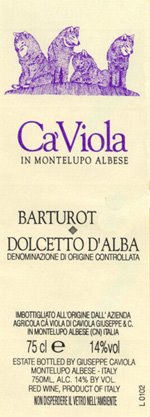
2003 Ca'Viola Dolcetto d'Alba Barturot

It's Halloween and the ghosties and ghoulies will be out soon, so I came home early to make some soup to slurp between the rings at the doorbell and to bring some warmth to what it turning out to be a rather chilly and grey day. Perfect for trick-or-treaters, less so for the rest of us.

I thought the wine to go with my hearty Nigella Lawson minestrone might be this 2003 Ca'Viola Dolcetto D'Alba Barturot ($24.69, Costco). This is slightly above my normal price cut-off, but I do love dolcetto, which translates roughly from the Italian as "little sweet one." A grown-up treat then, or so I tell myself, and far better for me than diving into the bowl of candy set aside for the ghosties and ghoulies.

The Columbia Wine Guy over on Brim to the Dregs is working his way alphabetically through wine (great idea!) and he hit "D" just the other day and gave some great information on dolcetto, as well as a more budget-friendly recommendation than mine is tonight.

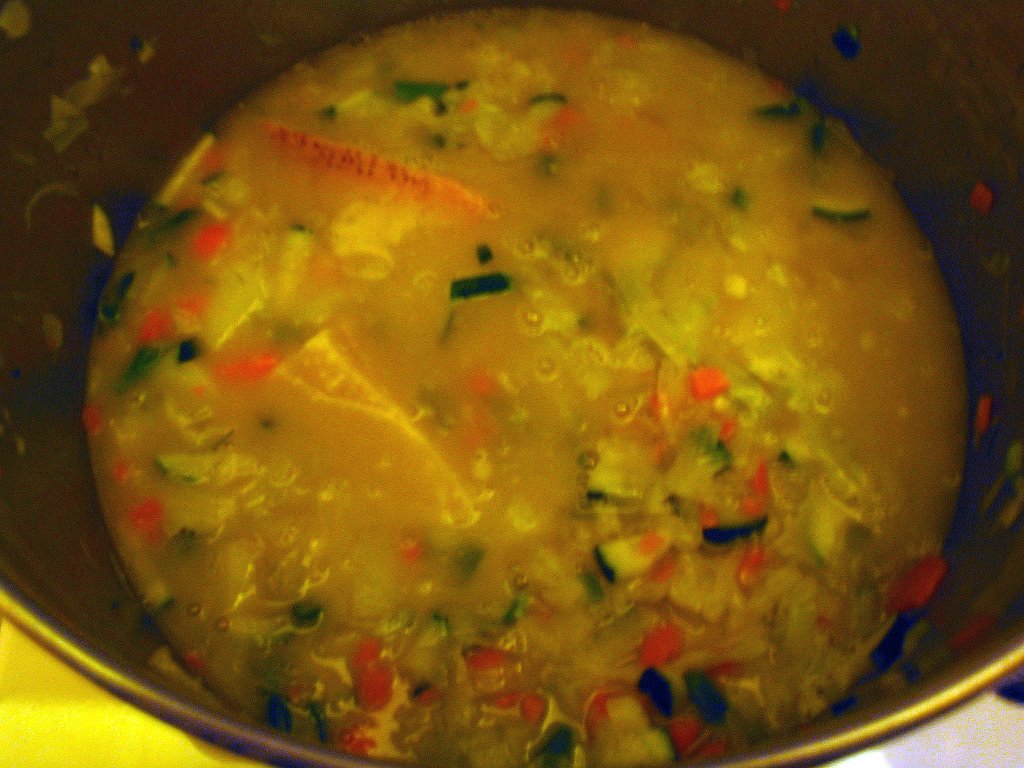
My minestrone recipe comes from Nigella Lawson's How to Eat (recipe not online). I should note here that this is not a tomato-based minestrone, but instead a pale, golden version with lots of vegetables and a special, not-to-be-omitted ingredient: a parmesan cheese rind. I tried to take a picture of my soup in the kettle (clearly a lot to be learned about this), to show both the color and (in the upper left) the rind bobbing around in the soup. The parmesan rind gives it a little kick of salinity, and a richness of flavor that is indefinable, but distinctive. On Ms. Lawson's advice, no parmesan rinds are thrown out in my house: they are all bagged up popped into the freezer to stick in soups, stews, and pasta sauces. (PS: You discard the rind before you serve the soup. It gets gummy. You are forewarned.)

On to the 2003 Ca'Viola Dolcetto d'Alba Barturot. Ca'Viola is in the Piedmonte region of Italy, and the oenologist, Giuseppe Caviola, has been dubbed the "King of Dolcetto" and received the 2002 Gambero Rosso Winemaker of the Year. This wine was made of 100% dolcetto d'alba grapes aged in stainless steel for 10-12 months. For those who have not tasted a red wine that has not had any oak aging, this is your chance.

The first impression you get of this wine is purple--the color of dark aubergines. Once you pick it up and take a good look at it you see it is really a true ruby red with lovely bluish tones to it. I found this wine needed a fair bit of time to settle down and open up. When it was first opened and poured it smelled very alcoholic (14.5% alch./vol.). Even after it's been in the glass a while the aromas are spicy rather than fruity. This is confirmed on the palate, which is predominantly spicy with an undertone of red fruit. Lots of acidity and a tinge of minerality at the end of each sip. It was much better with the food than as a stand alone wine.

I felt this wine needed a bit more fruit to balance out all those intriguing spice and mineral flavors, and that for the price this represented good QPR. If you are looking for a low-tannin, high-acid red with little oak influence that would go well with pasta with red sauces, it is for sale at many merchants throughout the US, and typically retails for under $30.