Showing posts with label Jamie Oliver. Show all posts

Monday, October 15, 2007

Bonarda: the Italian Wine from Argentina

Bonarda is a mysterious grape. It is the second most cultivated red wine in Argentina, but its origins lie in Italy. It was brought to Argentina by Italian immigrants in the 19th century. And viticulturalists still aren't sure whether the bonarda grown in Argentina is actually bonarda or charbono. No matter what the DNA tests eventually prove, this is a grape variety that produces low tannin, food-friendly wine. And if you can find an Argentinian bonarda, it is usually a wine that you can buy for a great price, too.

The 2005 Durigutti Bonarda certainly fit this profile: it was a great food wine at a terrific price. ($7.95, Chronicle Wine Cellar; $7-$10 from other merchants) It was a beautifully deep eggplant in color,which underscored its Italian roots for me. It had luscious aromas of blueberries, leather, and plums, which was a nice blend of the Italian and the Argentinian. There were low levels of tannin, and lots of silky blueberry and plum flavors, once the wine was in your mouth. I caught a bit of minerals in the finish, which kept the wine tasting clean and brisk. This was a slam dunk in the QPR department: excellent QPR.

We had our bonarda with a suitably Italian autumn meal: Jamie Oliver's tomato-based minestrone that was made with seasonal early autumn vegetables from the farmer's market. (hint: using dried or fresh beans really makes a difference, so buy some dried beans and soak them overnight before you make the soup. They will be far less mushy than the canned variety.) A hunk of rosemary bread, some flavorful cambazola cheese, and we had a satisfying meal that went together just beautifully. Most important, the tomatoes didn't clash with the tannin levels in the wine.

This is a wonderful fall red, as good with your last of the summer barbeques as it would be with soups, stews, and pastas. You may not be familiar with the grape, but once you've had it my guess is that you will be actively looking for wines made with bonarda on the wine store shelves.

Monday, March 26, 2007

Brunch and Bubbles: the NV Schramsberg Mirabelle Brut

I adore Sunday brunches. Especially in LA, when it is the only time of the week you can set a time for a meal and actually have people from all over the city reach your house on time. That's because late Sunday morning is the only time of the week when the traffic jams occur outside dim sum restaurants and not on the freeways.

Mostly, though, I love brunches because time seems to move more slowly during the hours of 11 and 3 on Sundays. The light seems more golden. The flowers smell sweeter. And friends who make you laugh under most circumstances can make you hilarious for no good reason at all.

When I think brunch, I nearly always think "bubbles" right after. Sparkling wines, with their bright acidity and low alcohol, are perfect sippers for this occasion. And they can be cut with a variety of fruit juices and purees--raspberry, peach, orange, pink grapefruit--if you want to prolong the pleasure and cut the alcohol even further. But of course you don't want to pull out a vintage French champagne at a casual, friendly brunch. Save that for the big celebrations.

Instead, opt for a budget-friendly California sparkler, like the NV Schramsberg Mirabelle Brut ($14.99, Trader Joe's). Schramsberg was founded in 1862 by Jacob Schram, a German immigrant with a viticultural background. The winery fell into disuse and dereliction, and was rescued by Jack and Jamie Davies in 1965 who saw the enormous potential in the vineyard site and the caves that peppered the hillside. Their son, Hugh, now runs the place and makes a full line of sparkling wines. The Mirabelle Brut is made from a blend of chardonnay and pinot noir grapes from Napa, Sonoma, and Mendocino. The juice is divided, some is aged, and then they are blended from many vintages until they achieve the Schramsberg house style.

The NV Schramsberg Mirabelle Brut was a very good QPR sparkler with a great deal of complexity for the price. It had a pale, buffed straw color and a nice, biscuity aroma that mixed with some hints of lemon. Citrusy, nutty, and toasty flavors enhanced the warmth of the afternoon, the soft spring air, and the companionship of good friends. It managed to be soft and refreshing, with its acidity and toast kept in nice balance and a soft, smooth bead/bubble adding to the pleasure that this wine gave.

We had the wine with an egg tart made with carmelized red onions, goat cheese, and pancetta from a great cookbook called California Home Cooking that makes the most of the local produce and foods from the great state of CA. Written by Michele Anna Jordan, author of the popular Cook's Tour of Sonoma, the recipe I used is not online, but some of her other wonderful recipes are and can be found by clicking here. With it we had a trio of salads pulled from Jamie Oliver and the Barefoot Contessa including smashed tomatoes and olives, pea and pesto, and a grilled zucchini salad with mint and basil. The meal tasted like a spring Sunday, and was the perfect companion to the sparkling wine.

If you haven't thrown a brunch lately, pick an upcoming Sunday, get some friends together, buy a few bottles of affordable bubbly, and settle in for a wonderful and relaxing afternoon. And don't forget to toast spring while you're at it.

Monday, January 15, 2007

Noir with Terroir: the 2003 Campion Edna Valley Pinot Noir

With my love of woodcuts, is it really any surprise that this label from Campion Wines would also catch my eye? Its roguish raccoon, reclining maiden surrounded by fruits and leaves, and map of the Edna Valley appellation drew me like a magnet in the wine store. The map was a clue to the character of the wine inside, which was oozing with terroir. Campion's winemaker, Larry Brooks, believes in terroir, and that grapes reflect the soil in which they are grown. I certainly could believe that after tasting this wonderful wine.

The 2003 Campion Pinot Noir Edna Valley ($15.95, Chronicle Wine Cellar) represented very good QPR. It was cherry red in color, with faint earthy aromas. Sips of the wine revealed cherries combined with earth, herbs, and a slightly mushroomy flavor. As time passed, more mushroom and earth flavors convinced me that this was a pinot noir with terroir, and less a pinot that emphasized fruit. This wine could have been more intense up front, but it was very complex and interesting as you held the flavors in your mouth after each sip, and remembered the slightly silky texture that kept it all interesting. We had it over two days, preserving it with one of those little cans of inert gas, and it continued to develop and the fruit and earthy flavors became more integrated. For this reason, I think this pinot noir is still at the beginning of its life and could last for a few years in a cool, dark place.

As if proving the value of terroir, this 2003 Edna Valley contrasted in interesting ways with the 2004 Campion Central Coast that I had at Colorado Wine Company last week. It was a year younger, made with fruit from Edna Valley and other areas within that appellation, and had the addition of pinot gris. Still, it was remarkable how much more fruity it was, with not nearly the complexity and earthiness than the wine made exclusively with Edna Valley fruit.

Campion is a name to watch, and was named one of the up-and-coming California wineries by Dan Berger in Tom Stevenson's Wine Report 2007. I'd love to tell you more about how the wine was made, but the Campion site hasn't been updated recently, so there was no more detailed information available on this wine. I did find a few bottles on line from merchants on both coasts through Wine-Searcher at a higher price, but be careful you're getting the Edna Valley since Campion releases several pinots from different appellations.

The ideal meal to go with any Pinot Noir with fulsome terroir--the Campion or someone else's--is Jamie Oliver's simple mushroom pasta dish. Made with silky pappardelle noodles, combined with a simple sautee of mixed mushrooms, garlic, dried chilis, parsley, and butter, it is the perfect match with any earthy pinot that you might have in your closet.

Wednesday, December 27, 2006

A Sugar Plum of a Wine: the 2003 Ferrari-Carano Siena

The 2003 Ferrari-Carano Siena ($16.69, Costco) is a red blend made up of Sangiovese, Malbec, and Cabernet Sauvignon with a touch of Petit Verdot. As I said in an earlier post, I prefer red blends that have a rhyme or a reason to them, and I cannot for the life of me figure this one out. The Ferrari-Carano website explains that to reflect their Italian heritage they blended Sangiovese with "Sonoma County's finest grapes." OK, but why? And why blend Sangiovese (plummy) with Malbec (more plummy)? A huge fan of their Fume Blanc wine, which is one of the great values in California Sauvignon Blanc, and their Syrah, I decided to give this red blend a try.

Despite my reservations, when I popped the cork and poured this wine into the glass it had a beautiful darkly reddish purple color to it. Sniffing the wine, I could detect aromas of black licorice candy and plums along with a slightly hot, alcoholic note. Drinking the wine brought out pronounced plummy flavors, with notes of cinnamon. This sweet and spicy wine has good QPR, with the plummy flavors characteristic of Sangiovese and Malbec (along with the Sangiovese cinnamon), but it is a bit pricey for a rustic red blend. I'm not sorry I had it, but I'm not sure I'd seek out another bottle, either.

We had the Siena wine with a traditional Italian dish done up the Jamie Oliver way: pollo alla cacciatora (aka Chicken Cacciatore). After pouring all of our remaining 2004 Big House Red over the chicken for a long slow marinade (the chicken is cooked in the marinade later), and combining a flavorful blend of tomatoes, anchovies, bay leaves, and olives it was popped into a low oven for 1 1/2 hours. It was rich, earthy, and pungent with all those anchovies and olives. This robust, saline fare was a perfect foil for the plummy sweetness of the Siena.

Monday, October 09, 2006

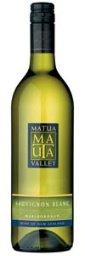
2005 Matua Valley Sauvignon Blanc


Another recent purchase from Chronicle Wine Cellar in Pasadena was this 2005 Matua Valley Sauvignon Blanc for $7.95. This is very widely available through internet outlets, and I've seen it in some area supermarkets, too.

I popped this in the fridge in the late afternoon to chill a bit, then had a glass while dinner was finishing up in the oven. Tonight we're having a Jamie Oliver pot-roasted chicken with sweet and sour sauce from his Happy Days with the Naked Chef. The recipe is not online, but it would be a great dish for entertaining since you just chop things up, throw them in the oven for 1.5 hours and then plate it and whizz up the sauce in the food processor from the veggies that have roasted under the chicken.

Matua is New Zealand winery that produces a full range of wines. I find that New Zealand Sauvignon Blancs are a bit more restrained and subtle than the lush, tropical Australian Sauvignon Blancs. While I love them both, I decided I wanted something that would compliment, rather than compete with, the ginger and strong flavors in the main dish we are having tonight.

Like most sauvignon blancs, the 2005 Matua is light, flavorful, and tangy. It is a pale lemon color. When you first smell it, the overwhelming impression is one of fresh cut grass. There is nothing aggressive or green-peppery in the aromas. You may catch a whiff of lime or citrus. When you taste it, the taste impression is also herbal, with a bit of lime on the end. This wine has 13.5% alch/vol. and has none of the vanilla or oak flavors associated with ageing in oak.

I think this wine has a very good Quality/Price Ratio (QPR) at $7.95. This would be a good compromise wine for those who find French sauvignon blanc hard to find, but are not always happy with the lush, fruity Australian sauvignon blancs. There is none of the mineral taste you find in a good French sauvignon blanc here, but it is still delicious.

Saturday, October 07, 2006

2005 Pierre Chermette Beaujolais


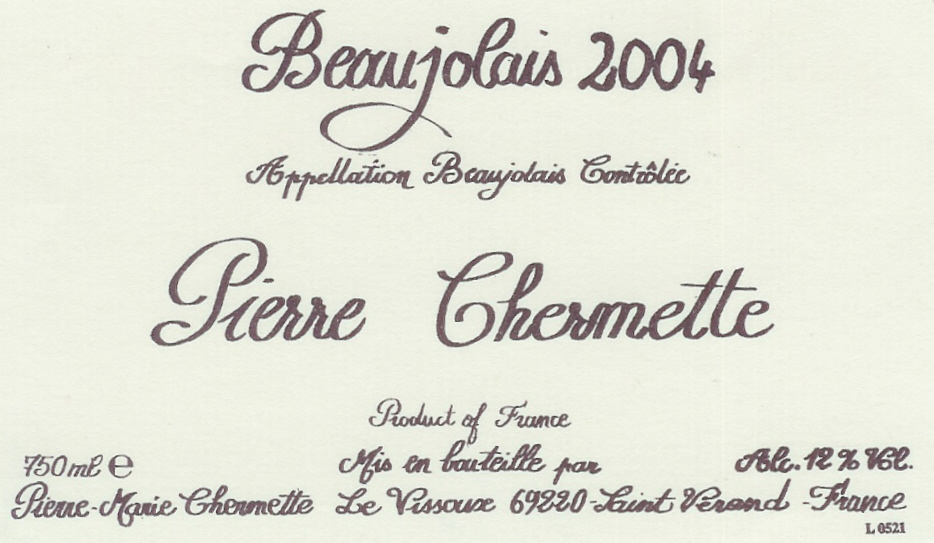
I purchased this wine about 10 days ago at Chronicle Wine Cellar in Pasadena, CA for $10.95. They are a great source for excellent wine buys in the LA area with unusual selections not found in supermarkets and a knowledgeable and helpful staff. They have an email list that you can subscribe to for cellar updates. To give you some sense of what the label looks like, I borrowed this from the 2004 vintage. The Chermette Beaujolais is also available online through wine merchants (find them by checking on Wine-Searcher).

This is a gamay wine, not as light and fruity as the better-known beaujolais nouveau but still not a heavily-oaked Napa cabernet sauvignon, either. It is a simple, fruit forward wine that ideally should have a silkiness of texture and low alcohol, making it easy to pair with a variety of food choices. This is a pleasant 12% alc/vol.

You can read more about Pierre Chermette and his vineyards by clicking here.

When I opened and poured out the first glass, it was ruby in color, with purple edges. The aromas were of cassis, raspberry, and a whiff of alcohol. When you tasted it it was full of black and red raspberrys and was slightly spicy. The wine had a surprisingly nice finish for a light red wine.

I had a glass while dinner was cooking, and because of the alcohol aromas (and because it was about 75 in the kitchen today, not cellar temp!), decided to pop it in the fridge for about 15 minutes to see how chilling it slightly worked for the wine. Beaujolais wines are excellent summer reds and bbq wines because they are often best slightly chilled.

Dinner tonight was herb roasted pork--an ideal match for the beaujolais. With it we had honey-roasted sweet potatoes and a great Jamie Oliver salad with peaches, prosciutto and mozzarella. The wine was a nice counterpoint to the herbs and garlic on the pork--rich without being too acidic or tannic. It helped to pick up a slightly herbal note in the wine. And the chilling did help with the alcohol.

Overall, this wine has excellent QPR and would make a food-friendly choice for grilled meat, bbq, and pasta dishes.