Showing posts with label piedmonte. Show all posts

Monday, March 16, 2009

New Grape of the Month: Cortese

I'm continuing to explore the Italian wine region of Piedmont this month, and today I have a new grape: Cortese.

Cortese is a grape indigenous to the Piedmont that makes bright, refreshing white wines. If you want to know more, follow the link to AbleGrape where (as the founder so rightly reminded me!) there is lots of information available.

Like many Italian whites, Cortese is lean and acidic--a far cry from the fruit-bombs many of us are used to drinking. As such it represents a delightful change of pace and gives your palate a good spring cleaning.

Recently I tried the 2006 Tenuta Merlassino Gavi, a very good QPR example of the grape. ($16.84, Garagiste; available elsewhere for around $20) Though the label here is for the 2005, we drank the 2006 and the label was identical. There were characteristic aromas of oily minerals, apple, and bitter almond. These aromas were followed up with flavors of apple and stony mineral water (Vitel was my pick) which were rounded up with a bitter aftertaste. The texture of the wine was slightly spritzy on first opening, then it smoothed out into a wine with a medium-bodied mouthfeel.

Fish is the typical food pairing for a Cortese, but I wanted to pick out the oily mineral notes and so made orecchiette with fresh tomatoes and an almond-pecorino pesto. The almonds did just what I hoped they would--they picked out the mineral and turned them nutty. And the wine's bracing acidity stood up nicely to the tomates and the basil.

If you like Italian whites--Pinot Grigio, Vermentino, Verdecchio, Garganega--I think you'll like Cortese. Give it a try if you see it on the shelf.

Wednesday, February 18, 2009

Wine Blogging Wednesday #54: Piedmont

Welcome to Wine Blogging Wednesday 54, the monthly online tasting event dreamed up many moons ago by Lenn Thompson of Lenndevours.

This month our host is David McDuff, who blogs about food and wine at McDuff's Food and Wine Trail. For his theme he picked the wines of Italy's Piedmont region. I was thrilled, since GWU$20 will be focusing on Piedmont as part of my ongoing Italian wine project, and this way I get to learn a lot from other wine bloggers before I start my own journey into the grapes of the region.

Piedmont is second only to Tuscany in terms of its high international reputation among wine lovers, and many serious collectors prefer the wines of Piedmont because of their subtlety and finesse. Because wines from the Piedmont are coveted, they are also costly--but there are varieties (such as Barbera) that often make their way into less expensive bottlings.

To get a sneak peak of what's in store for me next month, I looked through my cellar and found a bottle of Barbera, the Piedmont's fruity, drinkable grape. What I discovered was that the 2006 Stefano Farina Barbera d'Alba, was not so fruit-forward at this stage of its life. But perhaps it was the better for it. ($8.95, Chronicle Wine Cellar; available elsewhere for $9-$13).

The wine had aromas of plum and tobacco, which already told me that this was going to be a wine that was better with food. The plums were present in the flavors, as well, and the tobacco turned towards something more reminiscent of black tea. There was abundant acidity at the center of the wine, and an herbal, plummy aftertaste.

Because of the wine's acidity and herbal, tobacco, and black tea flavors it was excellent with a tomatoey pasta dish, Strozzapreti with Tomato-Pancetta sauce. Accented by herbs and cheese, the dish really made the wine shine. Even better, it's quick to prepare so it's a perfect meal when you want something hot and comforting after a long day at work.

This may not be the most complex Barbera you'll ever drink but it's held up well in the year I've had it and I think it will continue to drink well for the rest of 2009. (note: the label is from a much earlier vintage, but it was all I had since I threw the bottle away before I snapped a picture!)

Thanks to David for a great theme, and I look forward to reading everyone's posts about wines from the Piedmont.

Monday, January 28, 2008

Grape Variety #91: Ruche

Ruche is one of those great Italian varietals of unknown origin that has been a local favorite for a long time and has recently been "discovered" by the rest of the world. Usually, this happens only after most of the vines of said grape have been ripped out to make room for some more familiar variety (like Cabernet). Today, between 30 and 40 producers in the hills near Asti in the Piedmont region of Italy grow enough Ruche to make about 10,000 cases of red wine. A fraction of that production goes into making a sweet, dessert version of Ruche using the passito method in which grapes are dried in the sun to concentrate their sugar before fermentation.

Enter Randall Grahm, the man behind Bonny Doon. For the past few years--before he started selling off chunks of the business to focus on biodynamic viticulture--he's been importing Piedmont wines made by Luca Ferraris and selling them with Bonny Doon labels. Ferraris provided a number of wines to Bonny Doon, including a red table wine made from Ruche, Barbera, and Syrah (check out Smells Like Grape's tasting notes on this wine), and one of the region's Ruche passito wines.

The 2005 Bonny Doon Vineyard Ruche di Castagnole Monferrato Passito Ferraris was one of the best dessert wines I've had from Bonny Doon. I paid around $19 for this through the wine club, but it's on sale for $22.00/375 ml, direct from the winery. Often I find their dessert wines so sweet they are downright undrinkable (the botrytized Roussanne is an exception). This wine reminded me of port in its sweetness and flavor palate, but it was lighter in texture and felt less heavy on the tongue. Where this wine really stood out, however, was in its aromas of roses and raspberries. They were so clear and distinct that it was easy to track those flavors as the wine slid over your tongue. It was perfect on its own, and equally delicious with a piece of dark chocolate cake.

Italy continues to amaze me with these indigenous varietals that have so much character, and are so infrequently seen on US wine store shelves. Based on my experiences so far, I have to recommend that if you see an Italian wine made from a grape you've never heard of, you should definitely try it. There are some great grapes out there, and the wines are often very good value.

Saturday, January 27, 2007

Drink Your Dessert

Sometimes, after a long, long day, you want a little treat after dinner but you don't want ice cream and you don't want cookies and you definitely don't want tea or coffee. What you want is something sweet but not heavy, relaxing but not stupefying.

You want Moscato d'Asti--even if you don't realize it. Sweet, softly sparkling, and low alcohol (usually 7-8%) Moscato d'Asti can turn any day into a little bit of a celebration and provide you with the perfect excuse to sit and think things over at the end of the day. Even better, Moscatos (those from Asti and those made in an Asti style) are often great bargains. The problem is that some of them are terrible--sickly sweet rather than soft and aromatic as they should be.

The 2005 Bonny Doon Moscato d'Asti "Il Giocoliere" ($15, straight from Bonny Doon) is a wonderful example of how good this wine can be. When you first open it and pour, it is unbelievably frothy, but once you taste it the bubbles are soft and minor players in the wine. Of much greater significance are the aromas--peach, orange blossom, spring flowers, jasmine. It's a whole garden right in your glass. Flavors of peach, honey, and melon follow. This is less a wine to have with dessert than it is a wine to have for dessert. But if you must have something, think simple: a peach, some sliced apples, or an almond biscotti.

Though this wine is marketed under the Bonny Doon label, it is made from Piedmonte grapes by the Cavellero brothers in a little village called Vesime. More expensive than some wines of this type, its lovely balance and complexity ensures that it is still a wine with very good QPR.

Tuesday, October 31, 2006

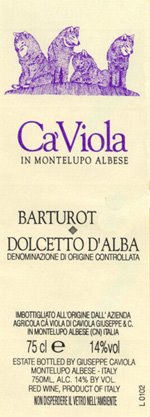
2003 Ca'Viola Dolcetto d'Alba Barturot

It's Halloween and the ghosties and ghoulies will be out soon, so I came home early to make some soup to slurp between the rings at the doorbell and to bring some warmth to what it turning out to be a rather chilly and grey day. Perfect for trick-or-treaters, less so for the rest of us.

I thought the wine to go with my hearty Nigella Lawson minestrone might be this 2003 Ca'Viola Dolcetto D'Alba Barturot ($24.69, Costco). This is slightly above my normal price cut-off, but I do love dolcetto, which translates roughly from the Italian as "little sweet one." A grown-up treat then, or so I tell myself, and far better for me than diving into the bowl of candy set aside for the ghosties and ghoulies.

The Columbia Wine Guy over on Brim to the Dregs is working his way alphabetically through wine (great idea!) and he hit "D" just the other day and gave some great information on dolcetto, as well as a more budget-friendly recommendation than mine is tonight.

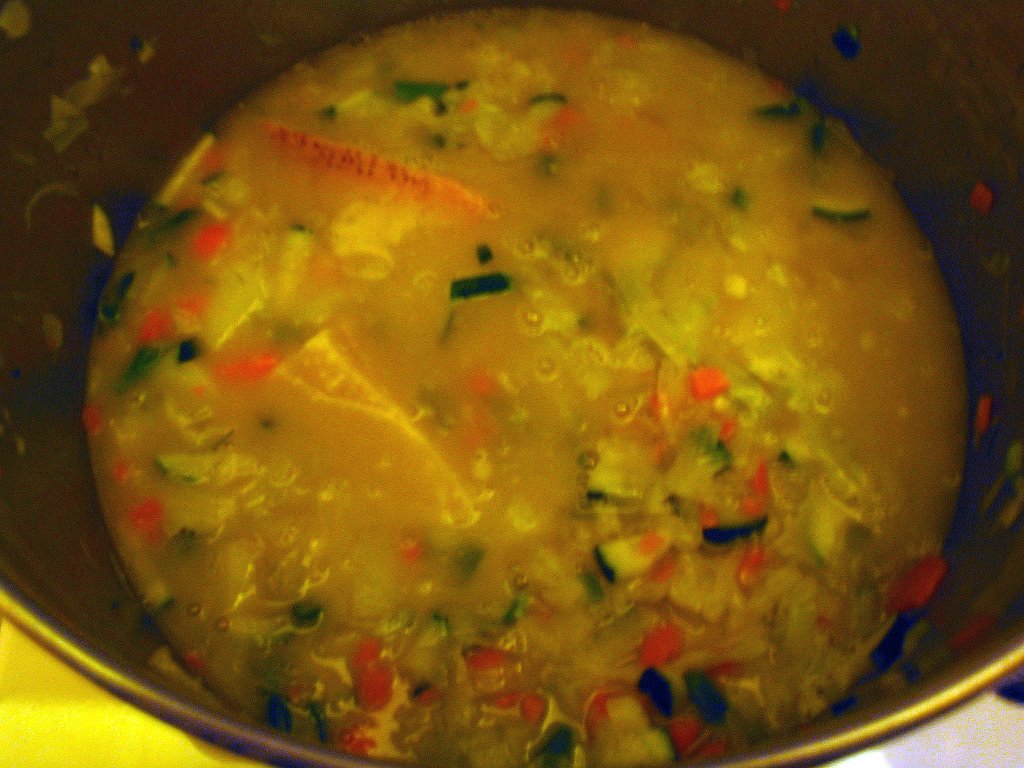
My minestrone recipe comes from Nigella Lawson's How to Eat (recipe not online). I should note here that this is not a tomato-based minestrone, but instead a pale, golden version with lots of vegetables and a special, not-to-be-omitted ingredient: a parmesan cheese rind. I tried to take a picture of my soup in the kettle (clearly a lot to be learned about this), to show both the color and (in the upper left) the rind bobbing around in the soup. The parmesan rind gives it a little kick of salinity, and a richness of flavor that is indefinable, but distinctive. On Ms. Lawson's advice, no parmesan rinds are thrown out in my house: they are all bagged up popped into the freezer to stick in soups, stews, and pasta sauces. (PS: You discard the rind before you serve the soup. It gets gummy. You are forewarned.)

On to the 2003 Ca'Viola Dolcetto d'Alba Barturot. Ca'Viola is in the Piedmonte region of Italy, and the oenologist, Giuseppe Caviola, has been dubbed the "King of Dolcetto" and received the 2002 Gambero Rosso Winemaker of the Year. This wine was made of 100% dolcetto d'alba grapes aged in stainless steel for 10-12 months. For those who have not tasted a red wine that has not had any oak aging, this is your chance.

The first impression you get of this wine is purple--the color of dark aubergines. Once you pick it up and take a good look at it you see it is really a true ruby red with lovely bluish tones to it. I found this wine needed a fair bit of time to settle down and open up. When it was first opened and poured it smelled very alcoholic (14.5% alch./vol.). Even after it's been in the glass a while the aromas are spicy rather than fruity. This is confirmed on the palate, which is predominantly spicy with an undertone of red fruit. Lots of acidity and a tinge of minerality at the end of each sip. It was much better with the food than as a stand alone wine.

I felt this wine needed a bit more fruit to balance out all those intriguing spice and mineral flavors, and that for the price this represented good QPR. If you are looking for a low-tannin, high-acid red with little oak influence that would go well with pasta with red sauces, it is for sale at many merchants throughout the US, and typically retails for under $30.

Monday, October 16, 2006

Field Trip to Piedmonte via the Heritage Wine Company, Pasadena

This afternoon we went out to see The Queen which we highly recommend and then over to the Heritage Wine Company in Old Town Pasadena for one of their weekend tastings. Heritage Wine is a great wine resource in the Los Angeles area, with a very knowledgeable staff and a great inventory, including hard-to-find German Rieslings, a nice selection of wines from Oregon, and a selection of Burgundies. You may not find many bargains here, but it is the place to go if you want excellent advice on special wine purchases.

Each weekend they offer special themes tastings in addition to the regular flights you can purchase (such as great whites, or interesting reds). The one we went to focused on the wines of Piedmonte in Italy. Tastings like this are great because they offer budget wine drinkers like me a chance to sip wines we might otherwise never purchase or taste (like Barolo).

There were six wines in the tasting, 2 whites and 4 reds:

NV Il Conte d'Alba Moscato D'Asti ($8.99)
2004 Fratelli Oddero Chardonnay($28.99)
2003 Icardi Pierino Barbera D'Asti ($16.99)
2004 Castello di Nieve Dolcetto D'Alba ($15.99)
2000 Giribadi Barbaresco ($49.99)
2001 Mauro Sebaste Barolo "Monvigliero" ($64.99)

None of us were that impressed with the whites, and the red that we liked best was the 2004 Castello di Nieve Dolcetto D'Alba, which I would give a rating of good QPR. It was a light bodied red wine, with a spicy, chocolatey taste. We felt it was a bit one-dimensional, and were not sure any additional ageing would improve this wine. This was in contrast to the Mauro Sebaste, which need another 2-4 years in a cool, dark place before the tannins balance out--not that any of us bought it to try the experiment!