Showing posts with label carignane. Show all posts

Monday, August 31, 2009

A True Blue Syrah from the Central Coast

I've said before that Syrahs often taste like a color to me. Sometimes, they taste black with inky blackberry fruit and dark spices. Sometimes, they taste red, and are full of a the bright fruit of a summer berry patch. Then there are the blue syrahs, that remind me of cool walks by the ocean and huckleberries.

I recently had a "true blue" example of the grape: the 2006 Clos LaChance "Black-Chinned" Syrah from the Central Coast. (a new release with a suggested retail $18; available through AmericanWinery.com, and check soon with your local merchant) One of the bottlings from Clos LaChance's "Hummingbird" Series, this wine had luscious aromas of blueberry and huckleberry that evoked the forest and seaside summers. I loved the silky blueberry flavors that followed, as well as the roasted herb and toast undertow that lingered in the juicy aftertaste. This good QPR Wine was well made and nicely balanced.

This Syrah went wonderfully with homemade hamburgers, pan-fried in a skillet with a zesty horseradish sauce and some bacon-onion relish. Its cooling blueberry-inflected fruit was a nice counterpoint to the horseradish, and the meatiness of the burgers brought out the roasted, toasted flavors in the aftertaste.

Full Disclosure: I received this wine as a sample.

Tuesday, August 05, 2008

A Rosé That Drinks Like a Red

For years the US was awash in a particular kind of rosé wine (White Zinfandel) that was soft pink, softly flavored, and sweetly innocuous. They were quaffers, with very little flavor and virtually no substance. Now, there are rosés for every taste, from light, salmon-colored dry Tavel to zesty Italian and Spanish wines made from a blend of full-bodied grapes. As you might suspect from seeing the dark color of the wine to the right, these richer, rounder rosés can drink more like red wines than white wines and stand up to everything from pepperoni pizza to grilled cheeseburgers without any problem.

Because they are chilled, they seem lighter and more refreshing than red wines--especially on warm summer evenings when just the thought of drinking a red can be a little daunting (even if you've stuck it in the fridge for a bit like you're supposed to in order to get its temperature down into the 60s).

We just had a robust rosé in the 2007 Pere Guardiola Floresta Rosado, which is made from a blend of Grenache, Merlot, and Carignane, which is known as Mazuela in this region. ($9.99, Weimax; also available from The Spanish Table for $11.99). It has the color of pomegranate juice: a very clear and dark red. When opened, you could smell raspberry, pomegranate juice, and even some cranberry. The flavor spectrum was more inclined to ripe raspberry, and there was some wet stone as well as a zing of cranberry in the aftertaste. There was a surprising amount of grip and pucker from tannins in the wine, but they only helped to balance out all the fruit. This was a juicy, flavorful wine that I think would be perfect for Indian Summer weather, and represented very good QPR for its reasonable complexity and attractive price.

This Pere Guardiola Floresta Rosado seems made for Paella or something spicy made with chorizo, but don't be afraid to pair it with other dishes. Rosés are very flexible when it comes to food pairings, and they seem especially adept at handling culinary curve balls and weird mixes of flavors and textures. I pasted together a vaguely Mediterranean meal with a slightly unorthodox chicken piccata, garlic mashed potatoes, and a salad of fennel, orange, and arugula. That's a lot for a wine to handle--garlic, lemon, orange, anise, garlic, artichokes, capers, and olives. And this wine handled it.

Even though the summer is waning, there's still at least eight good weeks of rosé weather ahead of us in most parts of this country. If you are looking for something a bit different than the pale salmon French rosés with which you started out the summer season, switch over to some rosés that drink like reds from Italy and Spain.

AVIN9416595147944

Wednesday, April 23, 2008

Pocket-Friendly Priorat

Two confessions to start out: first, I don't drink much wine from the Tarragona area of Spain known as the Priorat because they're usually out of my price range; second, I like a good fruit bomb every now and again, and occasionally even a wine that has been manipulated to suit A Certain Palate That Shall Be Unnamed.

That's why I decided to write about the 2004 Celler Can Blau from the Montsant DO, which forms a crescent shaped arc of vineyards around the much pricier Priorat DOC. There will be Spanish wine traditionalists who might take exception to my giving this a very good QPR designation, but honestly this is a seriously good buy for those of you who like bold, smoky reds. And if you haven't heard of Montsant, it's an appellation to watch out for if (like me) Priorat wines are often out of your price range.

The 2004 Cellar Can Blau is a terrific wine, that is drinking beautifully now. If you have a bottle, I think you might be able to hang on to it for as much as 18 months more, if you are keeping it carefully. The wine was rich plum in color, with decided aromas of smoke, leather, and blackberries. The ripe blackberry aromas continued through onto the tongue, where they seemed at times as if they were dipped in chocolate. The chocolate turned dusty, like cocoa powder, and melded with the bittersweet tannins and smoke of the aftertaste. Like many wines from the region, this is made from a blend of about equal parts of Carignan, Grenache, and Syrah.

That's a lot of wine for $12.69, which is what I paid for it in the summer of 2006 at Costco. I can't find it online any more, but I wanted to review it anyway because the 2006 vintage has been released and is in stores now, and seems to have a very similar flavor profile. The 2005 did not, from what I can tell (though I hasten to add I never drank it myself). I'd recommend you but a few bottles and drink them over the next few years. Expect to pay between $14 and $17 for the 2006 either online or at your local store..

Is this wine made for New World Palates? Absolutely. A tad spoofulated? Perhaps. Absolutely delicious? Yes, that too. A bargain? Undoubtedly. Once in a while a chocolate dipped blackberry fruit bomb is a delicious, opulent treat (and most readers probably have a wine that fits into this category, even if they usually prefer something leaner). What will I be drinking tomorrow? I think I'll have a Cabernet Franc to keep my palate on an even kilter.

Monday, October 29, 2007

Ghosts of WBWs Past: a Biodynamic Wine from the Languedoc-Roussillon

It's been a while since two of my favorite WBW themes: biodynamic wines (hosted by Jack and Joanne at Fork and Bottle) and value wines from Languedoc- Roussillon (hosted by Dr. Weingolb). Months later, I still find myself on the lookout for biodynamic and Languedoc-Roussillon bottlings, which is the true sign of a successful WBW, in my opinion. Other bloggers sometimes call these the "ghosts of WBWs past," because they, too, find themselves going back and reading the roundups and following up on some of the great reviews and finds that fellow bloggers bring out in the open. Just in time for Halloween I had one of these ghostly WBW experiences.

The 2003 Domaine Olivier Pithon Cotes du Roussillon Villages "Saturne" managed to cover two WBW themes in one bottle, since it's a biodynamic wine from the Cotes du Roussillon ($19.50, Red Carpet Wine Shop; available from other merchants for between $20 and $30). Like many wines from the south of France, this Pithon bottling was made from a blend of grenache, carignan, and syrah and had a deep, inky purple color. Either because it was made biodynamically or because it was from the Languedoc-Roussillon, I didn't find it was as aromatic as a Rhone wine made with these varietals. Still, there was loads of plummy fruit and some anise on the palate with a decided streak of minerality. This is what I associate most with biodynamic wines: a long mineral note that extends from the aromas through the last drops in the glass and beyond. Good QPR, especially for the price that I paid for it, though I would have liked it to have a little more balance between the fruit and the mineral notes.

If you are not living in LA (where it was 92 yesterday) then you may be thinking about stews, and this wine would be a good match with beef stew, or a roast chicken that sat in the oven just long enough to warm and perfume your house.

This wine has been positively reviewed recently by the LA Times, where it was included in a list of chic and affordable wines. Domaine Olivier Pithon has an excellent website, where you can learn more about their biodynamic farming practices and their line of wines, so I encourage you to head over there to learn more if you are interested.

Tuesday, February 20, 2007

That's Amore: the 2004 Forchini Papa Nonno

Every now and again I just need to watch Moonstruck. I love the scenes in the Italian restaurant, the dinners at home, and the omnipresence of wine throughout the movie. And then there's the soundtrack.

If you are in the mood for Italian-American food (spaghetti with meatballs, a pizza) a movie, and some amore, you might want to pick up a bottle of the very good QPR 2004 Forchini Papa Nonno red blend ($13.95, Chronicle Wine Cellar). Forchini Vineyards was started by up by Jim and Anita Forchini in 1996, after Jim had worked in the business as a wine maker for nearly two decades. (Previously he'd been a mechanical engineer--there is hope for us all!) The Papa Nonno is a tribute to Jim's grandfather Pietro Bernacchi, who arrived in the US from Lucca, Italy in1908.

The 2004 Forchini Papa Nonna ($13.95, Chronicle Wine Cellar) blends together red and a small amount of white grapes. With 58% Zinfandel, 27% Cabernet, 11% Carignane, and 4% mixed whites--nearly all from grape vines that are 50-90 years old--I found this to be a soft, medium-bodied wine. It was deep, inky garnet in color. I didn't get much aromas, just a little bit of red fruit and spice. Flavors of blackberry and brambles from the Zin were accompanied by mild spiciness and dusty tannins from the 19 months the juice spent in American oak. I thought that the winemakers did a good job capturing the bright acidity of a Tuscan chianti, even if there wasn't a drop of sangiovese in the mix. We had it with a pizza margherita and salad, which was a perfect pairing, but it would be equally good with spaghetti and meatballs, eggplant parmesan, or any other Italian-American favorites.

The 2004 Papa Nonna has received several awards, including a Silver Medal from the 2006 Sonoma County Harvest Fair and a Silver Medal from the 2007 San Francisco Chronicle Wine Competition. If you can't find this wine near you, and you can accept direct shipments, the wine is available through the Forchini's own website. Buon appetito!

Monday, November 27, 2006

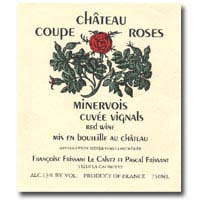
2003 Chateau Coupe Roses Minervois Cuvee Vignals


If you are looking for a fantastic red wine to serve with beef or other hearty winter fare, look no further than the 2003 Chateau Coupe Roses Minervois Cuvee Vignals ($16.99). I first saw this wine at Fowler's in downtown Durham, NC, where I was immediately drawn to the label (sucker for anything that looks like an old woodblock print) and was told that everyone in the store was talking about the wine. Then, to my surprise, I found it at the Surf Super in downtown Gualala. Unless you are located on the Sonoma coast between Stewart's Point and Elk, you are not shopping at the Surf Super. If you live in New Jersey, however, or are willing to have wine shipped, you are in luck. Wine-Searcher reveals that quite a few of these beauties are still available for purchase, and for even less than the $16.99 I paid for this.

Chateau Coupe Roses is owned by Francoise and Pascal Frissant. Located in the Languedoc, where Occitan culture flourished in the Middle Ages, and religious heresies were stamped out by church crusades. This was Cathar country, for the historians out there. The wine produced in the Minervois AOC is 96% red. The Wine Doctor has a great piece on the wines of the Minervois region, for those who aren't familiar with it. At Chateau Coupe Roses, they produce both whites and reds, and on their website, they talk about the alchemy that occurs in their region where a mix of high altitude coolness, and Mediterranean sunshine, provides the climate for the growing grapes.

This was a beautiful wine, from the moment the cork was pulled until the last unfiltered, unfined dregs settled in the empty glasses. Let me say right off the bat that if you close your eyes and don't read the label this smells and tastes like a fine Chauteauneuf du Pape from the Rhone. It is made of syrah, grenache, and old vine carignan. Dark, inky ruby in color, it had blackberry and sweet, heady aromas. Once you tasted it, there was more blackberry, and the briary garrigue notes characteristic of fine Mediterranean wine. Garrigue is an herbal, brushy flavor that is like no other flavor or aroma out there, but if you've been to the region and smelled the hot sun beat down on the scrub by the roads, you will recognize it. There was a long, spicy aftertaste and it still showed some tannins and grip around the edges. But in another year or so I imagine it will be perfectly integrated and even more luscious. At 13% alc./vol. it is proof that a wine doesn't need to be alcoholic and huge to deliver complex flavors.

We had this excellent wine with a ragu alla bolognese from an old copy of Cooking Light. A mixture of ground pork, veal, and beef were simmered with the classic bolognese vegetables (onion, celery, and carrots) for a long time, before some tomatoes and milk are added. It is somehow less oppressively tomatoey than a normal tomato-based meat ragu, and has a greater depth of flavor from the slow cooking with the vegetables. Perfect with this rich, flavorful wine from the Languedoc.

Only 600 cases of the 2003 Chateau Coupe Roses Minervois Cuvee Vignals were imported to the US, so run out and get some or order some on line if you possibly can. This wine represented excellent QPR, and was better than wines I've had that were twice or three times the price.