Showing posts with label dessert wine. Show all posts

Monday, December 13, 2010

Dessert Wines for Drinking and Gifting

I don't drink much dessert wine between January and November, but something happens to me at Thanksgiving and between then and New Year's Eve I find myself longing for a glass of sweet wine, a good book, and some holiday music.

Dessert wines typically come in smaller bottles (usually 375ml or 500 ml, rather than 750 ml), although there are exceptions. They are perfect for four to five people to share after dinner, and survive on the counter or in the fridge with a cork in the bottle for 3-5 days if you don't finish them up.

Though they are a bit more expensive than most of the wines reviewed on this blog, 'tis the season for gifting and indulging, so I decided to do a roundup of some of the more affordable bottles I've enjoyed recently in case you wanted to give a friend--or yourself--a bottle.

NV Martini & Rossi Asti Dolce ($6-8/375ml and $8-11/750ml) A sweet sparkling wine from Italy, this is frothy with ripe peach and honey aromas and flavors. Would be very nice with any desserts involving orchard fruits, and is a glass of this on its own is a dessert in itself! Very good QPR.

2009 Susana Balbo Torrontés Late Harvest (suggested retail $30/500ml; click here to find retailers in your area who might have it) A winning dessert wine from Argentina, with great acidity and spice along with honeyed citrus peel aromas and flavors. The wine becomes more flowery as it warms slightly and gets some air. This is a little like a Sauternes in its balance between sweetness and bright acidity. Very good QPR.

N.V. Rotta Black Monukka Dessert Wine (available for $26/375ml; also available directly from the winery) Exceptional in every way, this may well remind you of old and rare Palo Cortados or Olorosos from Spain. Fantastic caramelized orange peel and toffee aromas and flavors are rich and pure. This wine would be superb with pumpkin pie, caramel desserts, or with a selection of aged cheeses. Highly, highly recommended and a steal for the price. Excellent QPR.

2008 Susana Balbo Malbec Late Harvest (suggested retail $30/500ml;
earlier vintages available for $22-$30/500ml) This smells and tastes just like the holidays with cinnamon, clove, orange peel, and anise aromas and flavors. The wine has a silky texture, and is much lighter than a port. Bright red fruit, with cinnamon--yes, cinnamon--running from the midpalate through the finish. Very good QPR.

2005 Château Doisy-Védrines Sauternes (available for $23-$26/375ml or
$36-$60/750ml). A lush, affordable Sauternes with characteristic apple, honeycomb, orange peel, and a touch of pineapple. This wine is still very young, and will continue to improve with age but it is drinking just beautifully now. Excellent QPR.

Full Disclosure: I received samples of the Asti Dolce, Late Harvest Torrontes, Late Harvest Malbec, and Black Monukka wines for review. All other wines mentioned were purchased by me in the market.

Monday, August 24, 2009

A Sweet Tip on Dessert Wine

It's peach season--or at least that's the evidence from my local farmer's market. Nothing quite says late summer to me like some really ripe peaches, perhaps some vanilla ice cream, perhaps some meringues or madeleines, and a cool glass of dessert wine.

In the event this dessert suits you, too, and you don't have a stash of Sauternes begging to be opened,try to get your hands on some of the 2006 Bonny Doon Vineyard Le Vol des Anges Beeswax Vineyard ($25.50/375ml, club shipment from winery a few years back; still available in the market for $29-$33/750ml--but I'm dubious they're full bottles so check before you order).

I was very, very impressed with this wine, which was made from Roussanne grapes that had been blessed with "noble rot" or botrytis. While I often find US dessert wines much too sweet, and lacking in the acidity that brings balance to a wine, this bottling had a excellent balance. It also had a definite Sauternes-like aroma and flavor profile. The wine was a luscious deep gold in color with a satiny, slightly viscous texture. The aromas and flavors were very similar, with honey, quince, and candied lemon notes predominating. In spite of all that sweetness, there was a solid core of acidity that kept the wine from being too cloying. Kudos to Bonny Doon for this well-made wine that was worth every penny it cost. Though you may find dessert wines that are a tad cheaper, I have yet to have a domestic dessert wine this good for this price. Very good QPR.

So get yourself some peaches of other summer fruit, and treat yourself to an elegant dessert in the not too distant future. And if dessert wines are something you only drink at the holidays, nab some of this now while it's still available.

Sunday, February 08, 2009

This Week on Serious Grape: Wines for Your Sweetie

If you're looking for ideas on what to share with the one you love on February 14, I've got some in this week's Serious Grape column over on Serious Eats.

Rather than something that sparkles, why not try a dessert wine? (photo by robertpaulyoung)

Tasting notes for a few dessert wines I've enjoyed recently--along with some pairing suggestions--are just a click away.

Thursday, November 20, 2008

Wine Blogging Wednesday News

There is some news from Wine Blogging Wednesday.

First, #1 Wine Dude Joe Roberts posted his roundup of blog entries from the recent Wine Blogging Wednesday #51. The theme, as you might remember was "baked goods," and a variety of wine bloggers wrote up their experiences with dessert wines including Madeira, Malmsey, Sherry and Port. If you are looking for a perfect holiday treat, I highly recommend checking out the reviews.

Second, the theme for Wine Blogging Wednesday #52 has been announced. Tim, the "quaffmaster" from Cheap Wine Ratings, is our host and he's asked us to go out and find a value red wine from Chile. Post your reviews on December 10, and sit back and watch the value recommendations roll in from other bloggers. Want more details? Check out Tim's post.

Thanks to Joe for a great theme this month, and I've already got my red wine picked out and set aside for Tim's WBW #52. See you then!

Wednesday, November 12, 2008

Wine Blogging Wednesday #51: Baked Goods

Today is the 51st Wine Blogging Wednesday. Today's theme was picked by the #1 Wine Dude Joe Roberts. He asked us to drink something "baked." What Joe meant by this was he wanted us to pick a wine that had been deliberately heated and oxidized (otherwise known as Madeirized after the classic Madeira wines from Portugal).

Wisely, Joe realized that these might be hard to locate. So he gave us the option of tasting Port or Sherry instead.

Because life is fairly nuts right now with relatives stopping by and the semester winding to a close, I decided to write today about rare sherries. I had the opportunity to taste some when I was a guest of Osborne in May, and one of the reasons I wanted to highlight them today is because they are not only great wines, they represent excellent QPR if you are looking for a single dessert wine that you can have on hand during the holidays and serve over several weeks without them going off or tasting stale.

The reason why this is possible is because they have been fortified with Brandy. This means that if you stopper them up and keep them in a cool dark place you can drink them over weeks, and in some cases months. It also means that they pack a serious punch, so tiny glasses are in order.

N.V. Osborne Rare Sherry Pedro Ximénez Viejo ($100)
Quite simply, this is the best wine I have ever tasted. It opened to a thick blackish brown. At first, I tasted coffee, dark chocolate, and burnt sugar. As it opened, there was an increasing lift of candied lemon and orange peel, some molasses, and even coconut oil. Every time you took a sip, it tasted different--but every sip was delicious.

N.V. Osborne Rare Sherry Solera BC 200 (sorry--couldn't find this anywhere!)
This sherry was drawn from the famous “ABC” solera. The “A” barrels were sold to the Tsar of Russia, leaving 200 “BC” barrels. If you can get your hands on some (lucky you!) you will smell aromas and taste flavors of citrus, toffee, and a little black tea and a brandied cherry aftertaste. This wine was complex, fine, and unforgettable.

N.V. Osborne Rare India Oloroso ($78-$90)
The wine in this bottling is an average of 35-50 years old. This wine was all about caramel aromas and flavors. I tasted not only caramels but sea salt, toast, and burnt sugar. Another fantastic wine.

N.V. Osborne Rare Sherry Palo Cortado Solera PAP ($100)
A stunning sweet wine, with candied orange and toffee aromas. The flavors were a bit less sweet than the aromas suggested, turning to orange marmalade and brown sugar. Dessert in a glass.

N.V. Osborne Sherry 1827 Sweet Sherry ($11-$24)
A budget-friendly and more widely available version of the rare wine listed first, this is nothing like what you would expect. It is coffee-colored, with molasses and cherry cola aromas and flavors. It's so syrupy that I believe the people who told me that they serve it over vanilla ice cream in place of chocolate syrup. Sounds like a perfect dessert to me!

For those of you who think I've lost my mind to label a $100 wine "excellent QPR," fear not. I haven't lost my mind. For $100, you get the perfect ending to every holiday meal from late November all the way through late December. And if you are looking for a special gift for a wine-loving friend? This is it. Those of you on tighter budgets (like me) can get their hands on that 1827 Sweet Sherry and a pint of Häagen-Dazs and check "desserts" off your to-do list.

Thanks to Joe for a great theme, and one that brought back many happy memories of my time in Spain this spring. As usual, I'll have the roundup and the theme for next month's WBW for you when they're available.

Tuesday, October 14, 2008

Wine Book Club and Wine Blogging Wednesday News

Just a few news updates today, so get out your calendars and mark down these online wine blogging events.

First, on Tuesday, October 28, we'll have the Back to School/Politics 5th edition of the Wine Book Club. Join in as bloggers and readers throughout the blogosphere review and discuss Tyler Colman's new book, Wine Politics: How Governments, Environmentalists, Mobsters, and Critics Influence the Wine We Drink (University of California Press; $18.15 through Amazon) You may know Tyler Colman as Dr. Vino, who is hands down the best wine blogger out there. But the reason to read this book is not just that he's a wine blogger--he's an expert on this subject, and I can say (halfway through the book) that his writing is every bit as engaging and provocative here as it is on his blog.

It's easy to take part--get yourself a book, read it, and join in the conversation by posting a review on your own wine, food or book blog. You can also chime in the comments here at GWU$20 or any other site taking part. Or, you can post reviews on our sites at the Wine Book Club and Shelfari. For more details, check out my announcement post.

If you are a food, wine, or book blogger, I could use your help to post a reminder about this event. Participation has really dropped off since our bang-up start in January.

In other news, the theme for Wine Blogging Wednesday #51 has been announced by our host, Joe the #1 Wine Dude. The theme involves dessert wines, and Joe would like us to find something "baked"--as in Madeirized. In Madeirized wines have been intentionally oxidized to make them brown and nutty. Because they can be hard to find (except in Hungarian and Iberian bottlings) Joe has expanded "baked" wines to include wines that have been fortified (like sherries, ports, etc.) Reviews are due on November 12, and should give us all great ideas on what to serve for holiday dinners throughout the depths of winter. Here at GWU$20 you can look forward to some reviews of rare sherries that I tasted as a guest of Bodegas Osborne this summer, as well as a dessert idea using a "baked" wine.

Have a good week everybody, and see you back here tomorrow with a new white wine review--actually, two!

Tuesday, August 12, 2008

TAPAS Is for Tempranillo Lovers

On Friday I attended the first ever TAPAS event at Copia, the American Center for Food, Wine, and the Arts in Napa. TAPAS stands for the Tempranillo Advocates, Producers, and Amigos Society, and it has more than sixty wineries and vineyards in its membership. It was a great opportunity for me to learn more about Iberian varieties and how US wine makers and grape growers are using them to craft distinctive wines that are full of personality. (Picture of Earl Jones of Abacela Vineyards, the president of TAPAS, and other panelists)

There is a long history that helps to explain why Spanish varieties are relatively new players on the US wine scene. Most of it has to do with the government--as usual. When the Spanish came to the New World way back when, they wanted to protect the Spanish tax base and wine exports and so they prohibited the really good grapes from traveling overseas. What did this lead to? Colonists in pursuit of good wine grapes went to the French, Italians, and Germans which gave grapes like Chardonnay a leg up and put Spanish grapes way behind. Penelope Gadd-Coster of Coral Mustang Wines asked the million dollar question: "Where would Tempranillo be [now in the US] if Jefferson had not been a Francophile?"

The tasting that occurred in the afternoon was a real eye-opener for me and for most of the people there because how many times have you ever had a chance to taste 40-45 US Tempranillos side by side? Tempranillo is often likened to Cabernet Sauvignon for its versatility and quality, and that was true in the wines I tasted. I was struck by the wide range of flavors that the grape was capable of producing here in the US. There was everything from luscious, fruit-forward wines to bottles that would have been hard to identify as New World. Coral Mustang's 2004 Tempranillo from the Vista Creek Vineyards in Paso Robles ($22) had smoke, leather and a beautiful balance between these notes and the blackberry and black raspberry fruit. Tempranillo grapes have a smoky flavor, and this wine was made in neutral oak barrels, so any smoke was from the fruit, not the wood. The 2006 Bokisch Tempranillo (not yet released, around $22), had the same beef tea flavor that I last tasted in a 1991 Bodegas Montecillo Gran Reserva Especial from the Rioja, along with roasted herbs, earth, and a smoky aftertaste. The 2005 Six Sigma Tempranillo ($42), on the other hand, used French oak barrels when making its wine which resulted in vanilla aromas and juicy fruit flavors of blackberry and fig along with some coffee. I particularly liked Valley View Winery's 2005 "Anna Maria" Tempranillo from the Applegate Vineyard in Oregon ($24). It was very traditional in its flavors of cherry, strawberry, and cedar, and its lightness and elegance was striking. And Tempranillo is made for aging, as was clear in the 2005 Scribner Bend Black Hat Tempranillo ($14.95) with is cherry, strawberry, and smoke flavors and a core of bright acidity that will soften with time.

Tempranillo is also being used in blends, which is true in Spain as well. One blockbuster blend was the 2006 Twisted Oak The Spaniard, which has not yet been released but should please everybody with its ooh-la-la flavors and aromas of chocolate, cherries, smoke, and leather. The 2005 Core C3 Crazy Eights ($39) was made from a blend of 85% Tempranillo and 15% Cabernet Sauvignon. It had amazingly rich blackberry fruit flavors that exploded in your mouth, along with rich cedar and chocolate notes.

But the day wasn't all about Tempranillo. TAPAS celebrates all Iberian grape varieties, so there were people pouring wines made from other grapes like Touriga Nacional and Graciano, too. I tasted a 2007 Twisted Oak Graciano barrel sample that was one of the most interesting wines of the day, with its cranberry aromas, smoky aftertaste, and cherry and blackberry flavors. The NV St. Amant Tawny Port ($35) is made from 100% Bastarda and had heady aromas of raisins, toffee, and toasted nuts in a wine with a rich tawny color and a silky texture. Both Barreto and St. Amant produced excellent Tourigas, too. The 2005 Barreto Cellars Touriga (around $25, not yet released) was very drinkable with floral and spice aromas, spicy fruit red and black fruit flavors, and a soft finish. The 2006 St. Amant Touriga ($18) had aromas of violets and spice with cherry flavors, and a hint of beeswax in the aftertaste.

As for white wines, I think they are still a work in process. There is enormous potential in the Albarino grape, as well as in Verdelho. Albarino has the body to bump Chardonnay of its perch, and Verdelho should be on every table that is currently adorned with a simple Sauvignon Blanc, but right now the wines are a bit unfocused and I think the emphasis is on making quaffable wines. Nothing wrong with that of course, but I think we will see more wine makers trying to craft something more distinctive with these varieties. The 2007 Bokisch Mokelumne River Albarino ($16) takes a big step in that direction, with sensational aromas and flavors of orange blossom and buttered apples, balanced acidity, and a crisp yet juicy finish. This was an extraordinary and memorable white wine, and shows just how great Albarino can be.

Based on this event, I think we can all look forward to some golden years of drinking wine made with Iberian grape varieties right here in the US. It will be exciting to see what the grapes do as more vines are planted, and what wine makers do with the juice once more of it is available. If you haven't yet discovered these wines, you are in for a treat. If you have, let us know what your favorites are in the comments.

Friday, August 08, 2008

A Honey of a Second Label

All over the world, fancy winemakers blessed with more fruit than their limited production wines can use, or fruit that is almost but not quite up to their standards, are crafting wines under second labels. Here in the US, these second labels are often guarded as big secrets. I've had more than one person tell me who the real maker of a second label was as long as I promised not to reveal it. More open "secret second labels" include the great Napa Cab maker Larkmead's second label wine, Meadowlark. Once Gary V has outed you, it's pretty hard to achieve plausible deniability.

In an odd twist, France is quite open about its second labels. Lots of chi-chi makers have second labels, and they're quite proud of them. So it was with real anticipation that I opened a 2003 Sauternes bottled under the second label of the famed Bordeaux producer Chateau Suduiraut. Called Castelnau de Suduiraut, this is (like many second labels) an unbelievably good wine for an unbelievably good price. I received this bottle as a sample from the Bordeaux Wine Bureau, who puts out a list of the 100 top Bordeaux values every year.

To give you some pertinent details, the Chateau Suduiraut Sauternes is a premier cru wine from Bordeaux. The 2003 bottle scored 93 points consistently across the board, and had a suggested retail of $55 for 750ml (though that size bottle is now going for $50-$100). Right now the average price for a 375ml bottle of the stuff is $35.

The 2003 Castelnau de Suduiraut, on the other hand, is available at lots of places for under $15 in the 375ml format, and virtually every place for under $20. Want a bigger bottle? 750ml bottles go for $30-$50.

So how was it? In short, it was excellent QPR. The 2003 Castelnau de Suduiraut Sauternes was a lot of bang for the buck, and though not as transcendent and ethereal as some of the most expensive Sauternes, it was full of the spicy, sweet, and honeyed flavors that make this most people's favorite dessert wine. If you've had dessert wines in the past and found them unidimensional and sickeningly sweet, that's not what you experience in good Sauternes. Instead, the fruit I always think of is pineapple. There is a sweet yet acidic quality to a good Sauternes and this wine had it. It was honey-colored, and slightly less thick than some Sauternes that I've tasted. There were prominent aromas of pineapple, coconut, and honey and these aromas developed perfectly into the flavors. As the wine opened up a bit during the course of the evening, the flavors continued to deepen and gain some weight, which suggested to me that this wine--though delicious now--will be even better in a few years. Because it is not terribly sweet for a dessert wine I would think of pairing it with cheese and fruit for dessert, or just sipping it on its own.

If you are looking for some inexpensive but excellent Sauternes to try, or to buy in multiple bottles so you can stash them away and open one every now and again, this is a no-brainer choice. 2003 was an excellent vintage, and this is an excellent QPR way to get a taste of it.

Friday, April 25, 2008

Nectar

Dessert wines are often likened to nectar because of their sweet, potent flavors and their silky, syrupy texture. I have an orange tree and some enormous lavender in my back yard and since the weather turned warm here in southern California, I've been watching the bees getting drunk on the nectar they are pulling out of all the blossoms. When I walked by the orange tree the other day, there were so many bees drinking from the orange blossoms that you could hear this loud, distinctive buzz.

You'll feel like a honeybee yourself if you stick your nose into a glass of the 2005 Weiss Gruner Veltliner Eiswein. I've never had an eiswein--where the grapes literally freeze on the vine before they are harvested--made from the trendy Gruner Veltliner grape, but it was a real treat. I got this bottle as an unexpected birthday gift recently, but you can get yourself a bottle where he picked it up: at domaine547, where it will cost you about $26.99 for a 375ml bottle.

This rich wine was dark gold in color, with a bit of peachiness around the edges when it's poured into the glass. The wine smelled of apricots drenched in honey, which was interesting given the peachy-gold color that the wine had. Flavors of jasmine flowers, peach, and apricot rolled around your tongue and made you feel as if you were drinking in jasmine through an apricot-flavored straw. My favorite part of the wine, however, may well have been its caramel aftertaste. This richer, brown-sugared note helped to keep the wine's sweetness in check, as did the core of acidity at the center. A very nice effort, at a very nice price for an eiswein. Very good QPR.

As with most dessert wines, I drank it with a simple cookie, in this case some tiny waffle cookies called stroopwaffels. These have the same combination of honey and caramelized flavors I found in the wine, and picked up those notes beautifully. You can usually find bags of them at Trader Joe's, and they're quite good with a cup of coffee, too. That's how they're served in the Netherlands. In general, though, this dessert wine would be fabulous with anything that has brown sugar or caramel, including creme brulee and tarte tatin.

Thank you, Patrick, for this great birthday present! Buy yourself a present (even if it's not your birthday) and try a dessert wine soon. It was one of my wine resolutions this year, and even if you're late getting started, make like a honeybee and explore some of these nectared wines soon.

Monday, January 28, 2008

Grape Variety #91: Ruche

Ruche is one of those great Italian varietals of unknown origin that has been a local favorite for a long time and has recently been "discovered" by the rest of the world. Usually, this happens only after most of the vines of said grape have been ripped out to make room for some more familiar variety (like Cabernet). Today, between 30 and 40 producers in the hills near Asti in the Piedmont region of Italy grow enough Ruche to make about 10,000 cases of red wine. A fraction of that production goes into making a sweet, dessert version of Ruche using the passito method in which grapes are dried in the sun to concentrate their sugar before fermentation.

Enter Randall Grahm, the man behind Bonny Doon. For the past few years--before he started selling off chunks of the business to focus on biodynamic viticulture--he's been importing Piedmont wines made by Luca Ferraris and selling them with Bonny Doon labels. Ferraris provided a number of wines to Bonny Doon, including a red table wine made from Ruche, Barbera, and Syrah (check out Smells Like Grape's tasting notes on this wine), and one of the region's Ruche passito wines.

The 2005 Bonny Doon Vineyard Ruche di Castagnole Monferrato Passito Ferraris was one of the best dessert wines I've had from Bonny Doon. I paid around $19 for this through the wine club, but it's on sale for $22.00/375 ml, direct from the winery. Often I find their dessert wines so sweet they are downright undrinkable (the botrytized Roussanne is an exception). This wine reminded me of port in its sweetness and flavor palate, but it was lighter in texture and felt less heavy on the tongue. Where this wine really stood out, however, was in its aromas of roses and raspberries. They were so clear and distinct that it was easy to track those flavors as the wine slid over your tongue. It was perfect on its own, and equally delicious with a piece of dark chocolate cake.

Italy continues to amaze me with these indigenous varietals that have so much character, and are so infrequently seen on US wine store shelves. Based on my experiences so far, I have to recommend that if you see an Italian wine made from a grape you've never heard of, you should definitely try it. There are some great grapes out there, and the wines are often very good value.

Friday, January 18, 2008

A Perfect, Pink Dessert Wine: 2007 Innocent Bystander Pink Moscato

Dessert wines come in all shapes, sizes, colors, intensities, and prices. From thick, aromatic vintage ports to half-bottles of Sauternes with their honeyed sweetness, to fizzy moscatos, there's something for everybody. This year I'm going to make it a point to try some new dessert wines, because they are so often the perfect thing to top off a weeknight meal or a special dinner.

My first find for the year is the 2007 Innocent Bystander Muscat ($9.99/375ml, domaine547). What a great dessert wine, with its beautiful pink color and aromas of juicy peach and strawberry. You pop the crown cap on this little bottle, and everything about the experience is light, summery, refreshing, and fun. The flavors keep up this playful spirit, continuing with the peach and strawberry but adding some clementine to add some zing and freshness. This is a dessert wine that retains its crispness, and is not too sweet. For $9.99 this is a perfect wine to share with someone you love in the evening, or drink over several nights by yourself. I used a champagne stopper to seal in the bubbles and it remained pleasant to drink over the course of three evenings. Excellent QPR, with its great balance between sweetness and crispness and its fruity flavors.

You don't really need to eat anything with this wine, since it's going to satisfy all your post-dinner urges for something sweet and indulgent. But if you must, have it with a dark chocolate dessert, or with something very simple like madeleines, shortbread, or a bowl of berries.

Monday, December 31, 2007

New Year's Wine Resolutions 2008

Last year, I made a set of wine resolutions and I did pretty well. My Spanish wine adventures led me to enjoy wines made from grapes and in regions I never knew before. I drank lots and lots of sparkling wine and never got tired of it, I assure you. I beat back some of my Burgundy anxiety, although I'm more sure than ever that Burgundy is never going to be a big thing in my wine life--unless I win the lottery. I kept my wine costs down, spending on average just $14.31 per bottle of wine this year. (vintage New Year's card from ca. 1925)

What's in store for 2008? In addition to continuing to do what I'm already doing to find and evaluate great value everyday wines, I have a new set of wine resolutions that will shape the posts on this blog, and increase my wine knowledge over the coming year. Without further ado, here are my wine resolutions for 2008:

1. Read More Wine Books: There are a lot of great wine books out there, and to my embarrassment I've read relatively few of them. I own them; I just don't read them. I talked to some fellow wine bloggers and discovered they, too, had stacks of books that they wanted to read. So with a group of over a dozen bloggers we're starting a new online blogging event: a bi-monthly Wine Book Club. I'll announce the details and the first host on January 3, and your host will tell you what book is up first for discussion. This will work along similar lines to Wine Blogging Wednesdays, except that we're giving you 2 months to read the book and reviews and discussion will take place the last Tuesday of every other month (i.e. February, April, June, August, October, and December 2008). We hope that you will participate by joining us in reading some classic, new, and award-winning books. Unlike wine, you can get wine books everywhere--even your local library.

2. Get to know the wines of Italy.
I love Italy. I even read and speak Italian (but don't make me write it). So why are Italian wines such infrequent guests on my dinner table? I don't know the answer to that question, but I'm going to apply myself to getting to know Italian wines this year. With 21 separate regions and scores of indigenous grapes, it's going to be a fun resolution to keep and it may even take me two years to get from one end of Italy to the other. At my virtual side will be Terry Hughes, who writes the wonderful blog Mondosapore, and a stack of Italian wine books (some of which I may even read, see #1). I predict that by the end of the year Terry will dread finding my queries in his comments, but he was the inspiration for this year's geographic resolution, so hopefully he won't mind too much.

3. Finish out my Wine Century. The Wine Century Club is an organization of wine-lovers each of whom has tasted 100+ different grape varieties. Currently, I've tasted 85. The first 50 were easy, the next 35 fun but challenging, and the last 15--they required special purchases. So I've left no stone unturned, no shop unvisited, and have even managed to stay within my $20 ceiling and purchased varieties such as Romorantin, Teroldego and Nerella Mascalese . Happily, many of these varietals are Italian (see #2). Starting next week we'll be counting down the last 15 varietals to grape #100, so that I can put in my paperwork this spring. I highly encourage you to visit the site, get a form, and see where you are in your own Wine Century. It's fun, it' s a great way to learn more about wine, and you cross-train your palate with less familiar varietals and styles of wine making.

4. Dabble in Champagne without blowing my budget sky-high. Champagne, like Burgundy, does not play a large role in my wine life. To be honest, I find it daunting, and the price of the wines does not encourage amateur experimentation. Still, I should know more about champagne than I do, if for no other reason than it would be nice to get something more creative than Veuve Clicquot when I'm looking for a sparkling wine gift or treat for myself. I'm setting myself a limit of $50 for champagne, because it's SO expensive I cannot believe it. But, with some careful sleuthing and help from my friends in terms of recommendations, I want to get over my conviction that these wines are totally out of my price league and not worth the money. Stay tuned for the results, and if you have suggestions for particular makers please let me know.

5. Drink more dessert wines. As a rule, we don't eat dessert. But sometimes around 9 pm I want something sweet, not caffeinated, and comforting. This is the perfect opportunity to pour myself a small glass of dessert wine, and I sometimes do just that. I would like to know more about them, however, and try more sherries and ports. Catavino has been posting some great reviews of wines that sound perfect for winter nights, and I'm confident there's more out there to discover.

That should keep me busy for most of the year! What are your wine resolutions for 2008?

Wednesday, May 23, 2007

A Honey of a Wine

I love white dessert wines, never more so than in summer when their honeyed color, aromas, and flavors seem to contain the essence of the season. And, most white dessert wines (unlike ports or late harvest zinfandels) have relatively low alcohol levels, which is always welcome at the end of a meal, or on a hot day.

Recently I found a honey of a dessert wine made from muscat canelli grapes. The 2003 Robert Pecota Muscat Canelli Moscato d'Andrea ($11.99/375ml, Beverages & More) is perhaps the best value in US dessert wine I've ever had. They've been producing this wine for over 20 years, and it's no wonder. The wine is pale gold color, rather than the intense golden color of a sauternes or late harvest Sauvignon Blanc. Opening the wine I knew I was going to love it because of its pronounced aromas of honey and beeswax. Sipping the wine revealed a satiny texture, and as the wine warmed up there were lovely scents of honeysuckle, orange blossom, and lemon. These were echoed in the wine's flavors, and accompanied by a bit of rich creme fraiche roundness and tanginess in the finish. The wine's honeyed notes give it the illusion of botyritis, even though that is not present in this wine. Not overpoweringly sweet, and just 11.2% alc./vol., it is outstanding in its complexity. At a little over $10, this wine certainly qualifies as having excellent QPR. This wine is perfect to sip on its own, or pair it with some sliced peaches or a few simple cookies, such as madeleines.

Robert Pecota Winery has long been based in Calistoga, but the owners "downsized" in the summer of 2006 by selling their estate vineyard to Jess Jackson's Artisan label and moving to nearby Bennett Lane where they will continue to produce wines under the Pecota label. As the grapes for this wine come from the Solari Vineyard in Calistoga, I don't think the move will make a difference to production in this case. Here's looking to another 20 years of this delicious dessert wine.

Tuesday, April 17, 2007

What They're Drinking in Heaven

Sauternes. If there is a heaven, and I get there, this is what I'm drinking. Every day and every night.

It's magical stuff, an alchemical mix of Semillon and Sauvignon Blanc and a special rot called botrytis. Who knew fungus could taste so good.

There are shockingly expensive Sauternes (Chateau d'Yquem, anyone?), but there are also suprisingly affordable wines with rich concentration and a dazzling array flavors. So even if you're in the under $20 end of the wine budget spectrum, you can pick up excellent half-bottles of sauternes, which for a dessert wine represents quite a bargain.

The 2003 Ch. Sigalas Rabaud ($16.99/375 ml, K&L Wines), for instance, represents excellent QPR. It's an outstanding young Sauternes that really won't even hit its stride until 2008. Even as a relative juvenile, it already has abundant aromas and flavors of apricot, honey, and a wonderful toasted coconut note. Added to this, the wine is exhibiting a lovely, silky texture. The sweetness and acidity are in nice balance in this dessert wine, so you don't have to worry that this is somehow too sweet. It will be interesting to see how this wine is drinking in a few years when I open the next bottle. Hard to imagine it could get better, but the experts say it probably will.

What to have it with? Nothing. Just sit down, pour yourself and someone you love a glass, and put your feet up. Voila. You're in heaven.

They've been making wine at Chateau Sigalas Rabaud since at least 1660, and the Wine Doctor has a super profile of the chateau and its production, if you'd like to learn more. If you've never had any Sauternes, seek some out and give them a try. And if you love it already, please let us know which are your favorites and what you pair them with, if anything.

Saturday, January 27, 2007

Drink Your Dessert

Sometimes, after a long, long day, you want a little treat after dinner but you don't want ice cream and you don't want cookies and you definitely don't want tea or coffee. What you want is something sweet but not heavy, relaxing but not stupefying.

You want Moscato d'Asti--even if you don't realize it. Sweet, softly sparkling, and low alcohol (usually 7-8%) Moscato d'Asti can turn any day into a little bit of a celebration and provide you with the perfect excuse to sit and think things over at the end of the day. Even better, Moscatos (those from Asti and those made in an Asti style) are often great bargains. The problem is that some of them are terrible--sickly sweet rather than soft and aromatic as they should be.

The 2005 Bonny Doon Moscato d'Asti "Il Giocoliere" ($15, straight from Bonny Doon) is a wonderful example of how good this wine can be. When you first open it and pour, it is unbelievably frothy, but once you taste it the bubbles are soft and minor players in the wine. Of much greater significance are the aromas--peach, orange blossom, spring flowers, jasmine. It's a whole garden right in your glass. Flavors of peach, honey, and melon follow. This is less a wine to have with dessert than it is a wine to have for dessert. But if you must have something, think simple: a peach, some sliced apples, or an almond biscotti.

Though this wine is marketed under the Bonny Doon label, it is made from Piedmonte grapes by the Cavellero brothers in a little village called Vesime. More expensive than some wines of this type, its lovely balance and complexity ensures that it is still a wine with very good QPR.

Saturday, December 16, 2006

Saturday Wine Shopping--Feeling Sorry for Myself

Never, never go wine shopping when you are feeling sorry for yourself.

If you are a regular reader, you know that I am suffering from pre-holiday crazies, with too much work to do. And I'm not just back from Burgundy, like Brooklynguy. I'm not hiking through the wine country with Winehiker. And I'm not decorating my tree, baking cookies, or wrapping gifts because I have too much work to do. Sniff. (This is all rather pathetic really, since I have an awful lot to be thankful for this year and should be counting my blessings.)

So I cut myself a deal: if I got some work done, I could go to Chronicle Wine Cellar and buy some wine.

And so I did.

Chronicle Wines has lots of Italian reds, Cabernets from California, and French reds from the Rhone and Burgundy right now at wallet-friendly prices. Lots of good browsing and buying for holiday meals, and the store was full of happy customers (self included). If you need a break from all the hullabaloo, head on over there and check out their selection.

Inspired by reading all those Burgundian posts coming out of Brooklyn, I was in a definite French mood. I picked up a 2005 Domaine Raymond Dupont-Fahn Auxey-Duresses ($24.95, the label for the 03 pictured here). I didn't have my vintage card with me or I probably would have also bought a bottle of 1999 Pernand Vergelesses (sorry Neil, I can't remember the maker...). Also in the box when I left were a 1998 Chateau la Grave Ste. Croix du Mont ($12.95), a wine that I've never had but it is a dessert wine from an appellation across from Sauternes; and a 2005 Domaine les Grands Bois Cotes du Rhone Cuvee Les Trois Soeurs ($9.95). I continued my romp through the European labels with a 2003 Pago Florentino Tinto from La Mancha ($14.95) and a 375ml bottle of the 2003 Bodegas Arzuaga Navarro Ribera del Duero Crianza ($12.95/375ml and $23.95/750ml). Topping it off? A 2005 Scherer Pinot Noir from Alsace ($12.95).

As I sit among the bottles, with papers strewn all over my desk, the accusing blinking cursor on the computer is telling me its time to pull myself up by my bootstraps. Back to work, with the pleasant anticipation of some interesting wine to get me through the holidays and into the new year.

PS. It worked. Now I don't feel sorry for myself anymore. I feel vaguely guilty, though...

Wednesday, December 06, 2006

NV Krohn Tawny Port

Port. Like most wines, the very name evokes images and associations, whether it's champagne with its clinking glasses and popping corks, or cabernet sauvignon which immediately makes me think of steak, a house full of guests, and long conversations. For me, port conjures up leather armchairs, crackling fires, the Masterpiece Theatre theme, slippers, and pipe smoke. It is, in many ways, the quintessential winter wine, to be sipped after a hard day of holiday shopping when you're surveying the damage/loot and trying to take a moment out of the hubbub to enjoy the season.

It can be hard to find good port at a reasonable price. The finest vintage ports require years of cellaring before they reach their full potential and unless you are in the habit of buying them and laying them down for later, you are paying the wine makers and merchants for the cost of storage each and every time you buy a bottle of 20- or 40-year old port. Instead, you can buy the NV Krohn Tawny Port ($11.99, Whole Foods).

This excellent QPR port comes from the 19th century firm of Wiese and Krohn, which was established in Portugal by two Norwegians in 1865. Located in the Douro, Wiese and Krohn employ both traditional wine-making methods and modern technologies to produce their port. Like most makers of port, Wiese and Krohn make vintage port (made from grapes harvested in a single year to mature in the bottle), late-bottled vintage (LBV) ports (which are aged in casks for 6-7 years to accelerate the age process and then bottled) and non-vintage (NV) ports (ports made from a blend of grapes from different vintages and either aged in wood or in the bottle). Some of the finest ports in the world are the Krohn Colheita reserve ports, which earn rapturous tasting notes from appreciative drinkers. Today, the company sends 90% of its wine to Europe, with the US representing a smaller share.

As if the vintage, LBV, and NV labels on ports aren't confusing enough you can buy ruby, tawny, or even white port. Ruby ports are, as the name suggests, ruby in color. They are young ports that have been aged primarily in stainless steel and in the bottle to keep them fruity and vibrant. Tawny ports are port wines that have been aged in casks. This turns their ruby color into a dark amber and makes their flavors nuttier and more oxidized. Some tawny ports, however, are simply mixtures of ruby and white ports that are aged for 4-6 years. They are half-way between ruby and traditional tawny ports in color and flavor. White ports are often served on ice, like a cocktail.

Still confused? Check out Into Wine's excellent overview of this wine's history, bottling conventions, and restrictions.

Though there isn't a lot of information on the NV Krohn Tawny Port on the label or on the web, as best as I can tell from looking at it and drinking it, this is a tawny port that is made from a blend of ruby and white ports, and it has seen some time (ca. 4-5 years) in casks to give it a rich, round taste. This wine is still bright ruby in color, with pronounced aromas of raisin and some spice. As you sip it (preferably in front of a crackling fire) you taste more raisins, plums, and a hint of cinnamon. I found this NV Tawny more complex than most NV ports at this price, and it didn't have the cloying sweetness of some non-vintage ruby ports. It's nothing like an old, vintage port, but it is delicious and easy to drink--and a great value for the price.

Port makes an excellent dessert wine if you are serving fruit and cheese. One of my favorite desserts of all time is a slice of Huntsman Cheese, with its mixture of creamy Double Gloucester and pungent Stilton cheeses in gold and white layers like a cake, a handful of Carr's wholemeal crackers, sliced apple, and a glass of port. Even without the fire, it's the recipe for a perfect, relaxing winter's evening.

Sunday, December 03, 2006

Andrew Murray Tasting Room, Los Olivos


After we finished over at Bridlewood, we took the short trip along Rt. 154 to the charming town of Los Olivos, where there is a string of tasting rooms extending down Grand Street. (you can click on this map to enlarge the view, and you will see all the tasting rooms listed). Boutiques, galleries, restaurants, and other shops fill the streets of this small town.

We wanted to taste some Andrew Murray wines, and since their vineyards on Zaca Station Rd. are closed to the public, our goal in Los Olivos was to stop into the tasting room pictured here. On the way we picked up sandwiches at the branch of Panino just off Grand in the heart of town.

Andrew Murray is a UC Davis graduate who has received all kinds of press for his distinctive wines. He plants only Rhone varietals in his own vineyards, though he does also serve as wine maker for his neighbors at Oak Savanna. Murray is devoted to syrah in particular, and crafts his wines with the philosophy that good wines are made in the vineyard, and the winemaker "merely takes care of them" in the cellar. This is a winemaker who specializes in small production wines, and although you can sometimes find his Tous les Jours Syrah in shops, most of these wines are sold directly through the winery or in the tasting room. The Andrew Murray wines website is full of information, so I encourage you to take a look.

In the tasting room, you received 10 pours (9 Andrew Murray wines, and 1 Oak Savanna wine) for $10, and got to keep the Andrew Murray glass. Contrary to the tasting room website, it is not a Riedel "O" series glass, but at least it doesn't have a rounded edge! The wines poured for us included:

2005 Viognier, Santa Ynez Valley ($25): Aromatic with flowers, pineapple, and citrus, which come through as you sip the wine, too. Crisp, clean-tasting, and complex. 550 cases made. Good QPR.

2004 Enchante ($22):
A blend of two white Rhone varietals (Roussanne and Marsanne). Rich tasting with melon and oak aromas and flavors. More full-bodied than the Viognier, and a nice change from chardonnay for lovers of that varietal. 800 cases produced. Good QPR.

2004 Oak Savanna Vineyards Chardonnay Rancho La Zaca ($30):
An exceptional chardonnay, with pronounced pear aromas and flavors with a bit of citrus and a real streak of minerals. Bright acidity is kept in check with a little bit of oak. Round, complex, delicious. 350 cases produced. Very good QPR.

2004 Esperance ($22):
Murray's red blend intended to translate Chateauneuf du Pape to the soils of Santa Ynez. Grenache, Syrah, and Mourvedre are blended into a wine with black cherry, blueberry, cinnamon, and black pepper aromas and flavors. Delicious, and will be more delicious in a few years. 850 cases produced. Good QPR.

2004 Grenache Central Coast ($28):
Murray only bottles his Grenache by itself if the vintage is of sufficient quality, and the 2004 lived up to his standards. Raspberry, cranberry, and currant aromas and flavors. Unusually soft and drinkable for a 100% grenache wine, only 300 cases were produced. Good QPR.

2004 Syrah Estate Santa Ynez Valley ($25):
Made only with Syrah grown on the hillsides of the Santa Ynez appellation, this wine is full of cherry flavors and aromas with an interesting note of black tar. Oak is used, which makes it nice and smooth, but the bright acidity keeps it interesting. Perfectly drinkable now, or cellar it if you can wait. 1100 cases produced. Good QPR.

2004 Syrah Roasted Slope Vineyard ($34):
This is a big, interesting wine made from Syrah and Viognier grapes that are interplanted in the same hillside vineyard (just like in the Cote Rotie in France). The grapes are picked and fermented together. Black cherry, plums, and a hint of strawberry in the aromas and the palate. Would benefit from 2-10 years in the cellar to help round out all its edges, but I have no doubt in time it will be spectacular. 800 cases produced. Good QPR.

2004 Syrah Westerly Vineyard ($36):
Made from grapes from the eastern part of the Santa Ynez AVA. This produces Syrah with higher alcohol and lower acidity due to ripeness and less marine influence. This monster wine had 15.4% alc./vol. and didn't even taste alcoholic. Flavors and aromas were typical of the varietal, with blackberry and spice notes. 284 cases produced. Good QPR.

2005 Viognier Late Harvest ($20/375 ml):
A yummy dessert wine, with peach jam and honeysuckle aromas and flavors. On the back end you got a bit of apricot. Not as sweet as most late harvest viogniers, it would be excellent chilled and served on its own as a dessert, or with fruit-based desserts. Very good QPR.

I was really impressed with all the wines I tasted, and for Rhone lovers Murray is a name to watch. Murray does have a wine club, and given how few cases are made of these wines it is appealing to think of receiving them on a regular, reliable basis. The prices are a bit steep for me, but I did leave with a bottle of the Chardonnay, the Esperance, and the Late Harvest Viognier because they were so darn good.

Friday, November 24, 2006

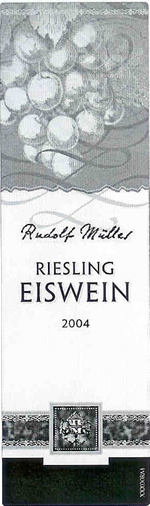
2004 Rudolf Müller Riesling Eiswein


Following on the heels of my introduction to ice wine, courtesy of Kitchen Chick's excellent November theme for Wine Blogging Wednesday #28 (you can read the round-up and tasting notes here), I saw the 2004 Rudolf Muller Riesling Eiswein ($18.99/375 ml) in the supermarket up here on the coast and we decided to give it a try.

This was a pleasant riesling eiswein. Made from grapes grown in the Pfalz region, it is golden in color, with an initial whiff of petroleum on first opening. This is characteristic of many German rieslings and does not indicate there is something wrong, but it may be off-putting to some. It was not as aromatic as it was flavorful, with apple, honey, white nectarine, and a touch of coconut flavors.

I think that this wine would be better with food, especially a blue cheese, or a huntsman cheese and crackers. The manufacturer also suggested the wine would go well with fruit tarts. As always, you'd want to be sure that ice wine was slightly sweeter than the fruit tart since the acid in the wine will make it seem crisper and less sweet once it's next to a sugary dessert.

Now that I've had two ice wines, I must say I preferred the vidal-based icewine I had earlier this month. I felt this wine, while pleasant and good QPR, tasted much like a sweet, syrupy riesling. The vidal ice wine, on the other hand, tasted like nothing else I've ever had before, and had great complexity. If you love rieslings, though, you may prefer this wine, with its familiar flavor palate. And this 2004 Rudolf Muller Riesling Eiswein would definitely be much easier to pair with food.

My ice wine knowledge is still a work in progress, and I will be continuing to seek out and explore these luscious dessert wines. There are definitely other riesling ice wines out there, and I look forward to tasting them in the upcoming months.

Sunday, November 19, 2006

Ice Wines Roundup from Wine Blogging Wednesday #27


Kitchen Chick rounded up all the wine tasting notes on ice wines from WBW#27. They can be found by clicking here, and then following all the links. There are lots of notes, all fun to read and informative, for these delicious dessert wines. The success of this WBW is a testament to Kitchen Chick's great theme. I know I learned a lot from the tasting, and from seeing what others tasted. Thanks again to Kitchen Chick, and don't forget: Wine Blogging Wednesday #28 returns on December 13 with Sparklers, hosted by Seattle's Culinary Fool.